Lecture 11: Multiple Integrals in Polar Coordinate & Its Engineering Application

Download the original PDF →


11.1 Cartesian Coordinates to Polar Coordinates​

We consider the borders of the region R in terms of x and y and integrate by that. It is how we learned to deal with integrating multivariate functions over a variety of different types of regions in the XY-plane. There will be times when it is far more practical to think about the region R in polar rather than Cartesian coordinates. Consider what would occur, for instance, if we tried to integrate the function f (x, y) across the region R below in Cartesian coordinates:

Figure 11.1

Figure 11.1

It would be challenging to set up the integral in Cartesian coordinates because the region's bounds are neither stated in terms of functions of x nor of y. Instead, we would need to divide the region into smaller sections and build an integral for each. The issue, however, would be made simpler by writing up the integral in terms of polar coordinates. Substantially, we will discover how to evaluate specific integrals using polar coordinates in this part.

Let's review some fundamentals of polar coordinates before delving into the method's specifics.

The Cartesian coordinates (x, y), where x and y are measured along the respective axes, can describe any point on the plane. Points on the plane can also be thought of in terms of the polar coordinates r and θ, so this is not the only way to represent them.

Fixing a point O, the origin, and an initial ray will let us construct the polar coordinate system (which generally corresponds to the positive part of the x-axis). Using the directed angle θ from the original ray to the segment OP and the directed distance r from the origin, we can characterize a point P in the plane as follows:

Figure 11.2

Figure 11.2

If we wish to convert a point's polar coordinates to Cartesian coordinates, or vice-versa, we can use a basic trigonometry to help us out. Recall that, if (x, y) is the Cartesian coordinate of a point with angle θ from the initial ray, and if x2+y2=r2x^2 + y^2 = r^2, then sin⁡θ=yr\sin\theta = \dfrac{y}{r} and cos⁡θ=xr\cos\theta = \dfrac{x}{r}:

So, if P has polar coordinates (r, θ), then we can rewrite the coordinates using the conversions x=rcos⁡θx = r\cos\theta and y=rsin⁡θy = r\sin\theta. Alternatively, if we have Cartesian coordinates (x, y), then we can determine r and θ using the formulas x2+y2=r2x^2 + y^2 = r^2, and tan⁡θ=yx\tan\theta = \dfrac{y}{x}. Summary of cartesian coordinates to polar coordinates:

Cartesian coordinatesPolar coordinates
xxrcos⁡θr\cos\theta
yyrsin⁡θr\sin\theta
f(x,y)f(x, y)f(rcos⁡θ,rsin⁡θ)f(r\cos\theta, r\sin\theta)

11.2 Double Integral in Polar Coordinate & Its Application​

If we convert rectangular coordinates to polar coordinates, it can often be considerably simpler to evaluate double integrals. But first, we need to define the idea of a double integral in a polar rectangular region before we explain how to execute this change.

When we defined the double integral for a continuous function in rectangular coordinates—say, gg over a region R in the XY-plane—we divided R into sub-rectangles with sides parallel to the coordinate axes. These sides have either constant x-values and/or constant y-values.

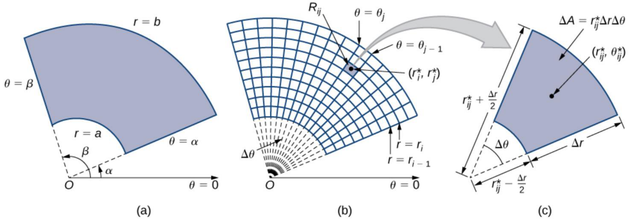
In polar coordinates, the shape we work with is a polar rectangle, whose sides have constant r-values and/or constant θ-values. This means we can describe a polar rectangle as in Figure 11.4, with R={(r,θ)∣a≤r≤b, α≤θ≤β}R = \{(r, \theta) \mid a \le r \le b,\ \alpha \le \theta \le \beta\}.

Figure 11.4 (a) A polar rectangle R (b) divided into sub rectangles Rij (c) Close-up of a sub-rectangle

Figure 11.4 (a) A polar rectangle R (b) divided into sub rectangles Rij (c) Close-up of a sub-rectangle

Consider a function f (r, θ) over a polar rectangle R. We divide the interval [a,b][a, b] into m subintervals [ri−1,ri][r_{i-1}, r_i] of length Δr=(b−a)/m\Delta r = (b-a)/m and divide the interval [α,β][\alpha, \beta] into n subintervals [θi−1,θi][\theta_{i-1}, \theta_i] of width Δθ=(β−α)/n\Delta\theta = (\beta-\alpha)/n. This means that the circles r=rir = r_i and rays θ=θi\theta = \theta_i for 1≤i≤m1 \le i \le m and 1≤j≤n1 \le j \le n divide the polar rectangle R into smaller polar sub-rectangles RijR_{ij} (Figure 11.4b).

As previously, we must determine the "polar" volume of the thin box above RijR_{ij} and the area, dAdA, of the polar sub-rectangle RijR_{ij}. Remember that in a circle with radius rr, the length ss of an arc under the influence of a central angle of θ\theta radians is equal to s=rθs = r\theta. As you can see, the polar rectangle RijR_{ij} resembles a trapezoid with parallel sides ri−1Δθr_{i-1}\Delta\theta and riΔθr_i\Delta\theta and a width of Δr\Delta r. Therefore, the polar sub rectangle RijR_{ij}'s area is:

ΔA=12Δr(ri−1Δθ+riΔθ)\Delta A = \tfrac{1}{2}\Delta r(r_{i-1}\Delta\theta + r_i\Delta\theta)

Simplifying and letting:

rij∗=12(ri−1+ri)r_{ij}^* = \tfrac{1}{2}(r_{i-1} + r_i)

we have

ΔA=rij∗ Δr Δθ\Delta A = r_{ij}^*\,\Delta r\,\Delta\theta

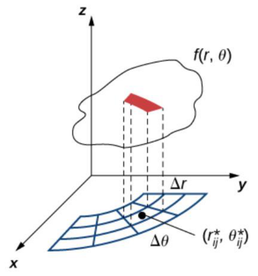
Hence, the thin box above RijR_{ij}'s polar volume (Figure 11.5) is

f(rij∗,θij∗) rij∗ Δr Δθf(r_{ij}^*, \theta_{ij}^*)\,r_{ij}^*\,\Delta r\,\Delta\theta

Figure 11.5 Volume of the thin box above polar rectangle, Rij

Figure 11.5 Volume of the thin box above polar rectangle, Rij

We obtain a double Riemann sum by applying the same approach to all the sub rectangles and summing the volumes of the rectangular boxes.

∑i=1m∑j=1nf(rij∗,θij∗) rij∗ Δr Δθ\sum_{i=1}^{m}\sum_{j=1}^{n} f(r_{ij}^*, \theta_{ij}^*)\,r_{ij}^*\,\Delta r\,\Delta\theta

As we have previously seen, as we allow m and n to grow greater, we get a better approximation to the polar volume of the solid above the region R. Consequently, we define the polar volume as the double Riemann sum's limit.

V=lim⁡m,n→∞∑i=1m∑j=1nf(rij∗,θij∗) rij∗ Δr ΔθV = \lim_{m,n \to \infty}\sum_{i=1}^{m}\sum_{j=1}^{n} f(r_{ij}^*, \theta_{ij}^*)\,r_{ij}^*\,\Delta r\,\Delta\theta

This becomes the equation for the double integral.

The following is the definition of the double integral of the function f(r,θ)f(r, \theta) over the polar rectangular region R in the r-θ plane:

∬Rf(r,θ) dA=lim⁡m,n→∞∑i=1m∑j=1nf(rij∗,θij∗) rij∗ ΔA=lim⁡m,n→∞∑i=1m∑j=1nf(rij∗,θij∗) rij∗ Δr Δθ\begin{aligned} \iint_R f(r,\theta)\,dA &= \lim_{m,n \to \infty}\sum_{i=1}^{m}\sum_{j=1}^{n} f(r_{ij}^*, \theta_{ij}^*)\,r_{ij}^*\,\Delta A \\ &= \lim_{m,n \to \infty}\sum_{i=1}^{m}\sum_{j=1}^{n} f(r_{ij}^*, \theta_{ij}^*)\,r_{ij}^*\,\Delta r\,\Delta\theta \end{aligned}

The double integral over a polar rectangular region can be stated as an iterated integral in polar coordinates, like the section on double integrals over rectangular regions. Hence,

∬Rf(r,θ) dA=∬Rf(r,θ) r dr dθ=∫θ=αθ=β∫r=ar=bf(r,θ) r dr dθ\iint_R f(r,\theta)\,dA = \iint_R f(r,\theta)\,r\,dr\,d\theta = \int_{\theta=\alpha}^{\theta=\beta}\int_{r=a}^{r=b} f(r,\theta)\,r\,dr\,d\theta

Observe that when using polar coordinates, the expression for dAdA is changed to r dr dθr\,dr\,d\theta. The polar double integral can also be viewed by substituting the double integral in rectangular coordinates. When the function f is expressed in terms of x and y, x=rcos⁡θx = r\cos\theta, y=rsin⁡θy = r\sin\theta, and dA=r dr dθdA = r\,dr\,d\theta, it becomes

∬Rf(r,θ) dA=∬Rf(rcos⁡θ,rsin⁡θ) r dr dθ\iint_R f(r,\theta)\,dA = \iint_R f(r\cos\theta, r\sin\theta)\,r\,dr\,d\theta

11.2.1 Double Integral in Polar Coordinate & Its Application​

Example 11.1​

∬Rxy dA\iint_R xy\,dA over the region Q, bound by x2+y2=4x^2 + y^2 = 4, x=yx = y and x=0x = 0

Solution

Steps:

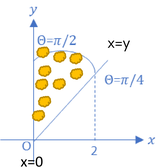
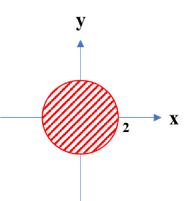
  1. Always draw the region first, x2+y2=4x^2 + y^2 = 4 is equation for circle,

    x2+y2=4x^2 + y^2 = 4 x2+y2=r2x^2 + y^2 = r^2

    Hence, r = 2

  2. x = y and x = 0.

    Region bounded by x² + y² = 4, x = y and x = 0

  3. Set up the integral

    ∫θ=π4θ=π2∫r=0r=2xy dA=∫θ=π4θ=π2∫r=0r=2rcos⁡θ rsin⁡θ r dr dθ\int_{\theta=\frac{\pi}{4}}^{\theta=\frac{\pi}{2}}\int_{r=0}^{r=2} xy\,dA = \int_{\theta=\frac{\pi}{4}}^{\theta=\frac{\pi}{2}}\int_{r=0}^{r=2} r\cos\theta\,r\sin\theta\,r\,dr\,d\theta

  4. Solve the double integral

    ∫θ=π4θ=π2∫r=0r=2r3cos⁡θsin⁡θ dr dθ=∫θ=π4θ=π2∫r=0r=2r3sin⁡2θ2 dr dθ\int_{\theta=\frac{\pi}{4}}^{\theta=\frac{\pi}{2}}\int_{r=0}^{r=2} r^3\cos\theta\sin\theta\,dr\,d\theta = \int_{\theta=\frac{\pi}{4}}^{\theta=\frac{\pi}{2}}\int_{r=0}^{r=2} \frac{r^3\sin 2\theta}{2}\,dr\,d\theta

    ∫θ=π4θ=π2r44⋅sin⁡2θ2∣r=0r=2dθ=14∫θ=π4θ=π216 sin⁡2θ2 dθ=∫θ=π4θ=π22sin⁡2θ dθ=(−cos⁡2θ2)θ=π4θ=π2=1\begin{aligned} \int_{\theta=\frac{\pi}{4}}^{\theta=\frac{\pi}{2}} \frac{r^4}{4}\cdot\frac{\sin 2\theta}{2}\Big|_{r=0}^{r=2} d\theta &= \frac{1}{4}\int_{\theta=\frac{\pi}{4}}^{\theta=\frac{\pi}{2}} 16\,\frac{\sin 2\theta}{2}\,d\theta \\ &= \int_{\theta=\frac{\pi}{4}}^{\theta=\frac{\pi}{2}} 2\sin 2\theta\,d\theta \\ &= \left(-\frac{\cos 2\theta}{2}\right)_{\theta=\frac{\pi}{4}}^{\theta=\frac{\pi}{2}} = 1 \end{aligned}

Example 11.2​

Evaluate ∬R(3x+4y2) dA\iint_R (3x + 4y^2)\,dA, where R is the region in the upper half-plane bounded by the circles x2+y2=1x^2 + y^2 = 1 and x2+y2=4x^2 + y^2 = 4.

Solution
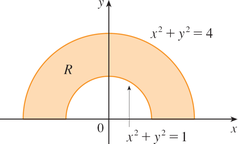
  1. Draw the region: It is the half-ring and in polar coordinates it is given by 1≤r≤21 \le r \le 2, 0≤θ≤π0 \le \theta \le \pi.

    Half-ring region bounded by x² + y² = 1 and x² + y² = 4

  2. Set up the integral

    ∫θ=0θ=π∫r=1r=2(3x+4y2) dA=∫θ=0θ=π∫r=1r=2(3rcos⁡θ+4(rsin⁡θ)2)r dr dθ\int_{\theta=0}^{\theta=\pi}\int_{r=1}^{r=2} (3x + 4y^2)\,dA = \int_{\theta=0}^{\theta=\pi}\int_{r=1}^{r=2} \left(3r\cos\theta + 4(r\sin\theta)^2\right)r\,dr\,d\theta

  3. Solve the double integral

    ∫θ=0θ=π∫r=1r=2(3r2cos⁡θ+4r3sin⁡2θ)dr dθ=15π2\int_{\theta=0}^{\theta=\pi}\int_{r=1}^{r=2} \left(3r^2\cos\theta + 4r^3\sin^2\theta\right)dr\,d\theta = \frac{15\pi}{2}

11.2.2 Evaluating a Double Integral Over a General Polar Region​

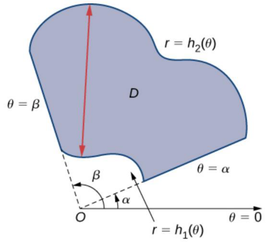
In this part, we consider two types of regions, which are comparable to Type I and Type II as stated for rectangular coordinates in section on Double Integrals over General Regions, to calculate the double integral of a continuous function by iterated integrals over general polar regions. We define a general polar region as r=f(θ)r = f(\theta) than θ=f(r)\theta = f(r), so we describe a general polar region as R={(r,θ)∣α≤θ≤β, h1(θ)≤r≤h2(θ)}R = \{(r, \theta) \mid \alpha \le \theta \le \beta,\ h_1(\theta) \le r \le h_2(\theta)\}

Figure 11.6 A general polar region between α ≤ θ ≤ β, h1(θ) ≤ r ≤ h2(θ)

Figure 11.6 A general polar region between α ≤ θ ≤ β, h₁(θ) ≤ r ≤ h₂(θ)

If f(r,θ)f(r, \theta) is continuous on a general polar region D as described above, then

∫θ=αθ=β∫r=h1(θ)r=h2(θ)f(r,θ) r dr dθ\int_{\theta=\alpha}^{\theta=\beta}\int_{r=h_1(\theta)}^{r=h_2(\theta)} f(r,\theta)\,r\,dr\,d\theta

Example 11.3​

∬Ry dA\iint_R y\,dA over the region Q, bound by x2+y2=2xx^2 + y^2 = 2x and x=yx = y

Solution

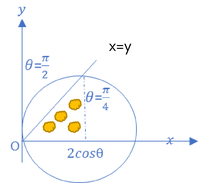
Region bounded by x² + y² = 2x and x = y

x2+y2=r2x^2 + y^2 = r^2 x2+y2=2xx^2 + y^2 = 2x r2=2rcos⁡θr^2 = 2r\cos\theta r=2cos⁡θr = 2\cos\theta

∫θ=π4θ=π2∫r=0r=2cos⁡θy dA=∫θ=π4θ=π2∫r=0r=2cos⁡θrsin⁡θ r dr dθ\int_{\theta=\frac{\pi}{4}}^{\theta=\frac{\pi}{2}}\int_{r=0}^{r=2\cos\theta} y\,dA = \int_{\theta=\frac{\pi}{4}}^{\theta=\frac{\pi}{2}}\int_{r=0}^{r=2\cos\theta} r\sin\theta\,r\,dr\,d\theta

=∫θ=π4θ=π2∫r=0r=2cos⁡θr2sin⁡θ dr dθ= \int_{\theta=\frac{\pi}{4}}^{\theta=\frac{\pi}{2}}\int_{r=0}^{r=2\cos\theta} r^2\sin\theta\,dr\,d\theta

Use integration by part to solve the double integral, you'll get

∫θ=π4θ=π2∫r=0r=2cos⁡θr2sin⁡θ dr dθ=16\int_{\theta=\frac{\pi}{4}}^{\theta=\frac{\pi}{2}}\int_{r=0}^{r=2\cos\theta} r^2\sin\theta\,dr\,d\theta = \frac{1}{6}

11.2.3 Application of Double Integral Using Polar Coordinates to Find Volume​

Example 11.4​

Find the volume between region x2+y2+z2=2x^2 + y^2 + z^2 = 2 and region z=x2+y2z = \sqrt{x^2 + y^2}

Solution

Both regions have the equation of sphere, find the intersection

x2+y2+z2=2—— (1)x^2 + y^2 + z^2 = 2 \quad \text{------ (1)} z=x2+y2————— (2)z = \sqrt{x^2 + y^2} \quad \text{--------------- (2)}

(1) – (2)

x2+y2=1x^2 + y^2 = 1

Hence, r = 1

Find which region is at top and bottom by plug in (0,0) into eq. (1) and eq. (2)

x2+y2+z2=2—— (1)  ⟹  z=2(top)x^2 + y^2 + z^2 = 2 \quad \text{------ (1)} \implies z = \sqrt{2} \quad \text{(top)} z=x2+y2————— (2)  ⟹  z=0(bottom)z = \sqrt{x^2 + y^2} \quad \text{--------------- (2)} \implies z = 0 \quad \text{(bottom)}

To find the volume between two regions, we need to know the zbetweenz_{\text{between}}

Hence, zbetween=ztop−zbottom  ⟹  2−x2−y2−x2+y2=2−r2−r2=2−r2−rz_{\text{between}} = z_{\text{top}} - z_{\text{bottom}} \implies \sqrt{2 - x^2 - y^2} - \sqrt{x^2 + y^2} = \sqrt{2 - r^2} - \sqrt{r^2} = \sqrt{2 - r^2} - r

Set up the integral:

∫θ=0θ=2π∫r=0r=1(2−r2−r)r dr dθ\int_{\theta=0}^{\theta=2\pi}\int_{r=0}^{r=1} \left(\sqrt{2 - r^2} - r\right)r\,dr\,d\theta

Solve the integral:

∫θ=0θ=2π∫r=0r=1r2−r2−r2 dr dθ=4π3(2−1)\int_{\theta=0}^{\theta=2\pi}\int_{r=0}^{r=1} r\sqrt{2 - r^2} - r^2\,dr\,d\theta = \frac{4\pi}{3}\left(\sqrt{2} - 1\right)

11.3 Triple Integral in Cylindrical Coordinate and Spherical Coordinate & Its Application​

11.3.1 Polar Coordinates Versus Spherical Coordinates​

To handle issues requiring circular symmetry more easily, we previously showed how to convert a double integral in rectangular coordinates into a double integral in polar coordinates. Similar circumstances arise with triple integrals. However, in this case, it is important to distinguish between spherical and cylindrical symmetry. This section transforms the triple integrals in rectangular coordinates into a triple integral in cylindrical or spherical coordinates.

As we have previously seen, a point with rectangular coordinates (x, y) in two-dimensional space R-2 can be converted to polar coordinates (rcos⁡θr\cos\theta, rsin⁡θr\sin\theta) and vice versa. The relationships between the variables are as follows: x=rcos⁡θx = r\cos\theta, y=rsin⁡θy = r\sin\theta, r2=x2+y2r^2 = x^2 + y^2, and tan⁡θ=(y/x)\tan\theta = (y/x).

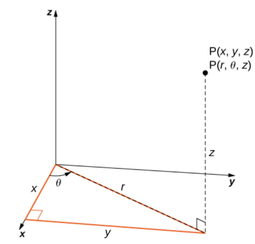
A point with rectangular coordinates (x, y, z) in three-dimensional space R-3 can be identified with cylindrical coordinates (r, θ, z), and vice versa. The vertical distance to the point from the xy-plane, added as z, can be calculated using the same conversion relationships.

Figure 11.7 Cylindrical coordinates are identical to polar coordinates with vertical z-coordinate as addition.

Figure 11.7 Cylindrical coordinates are identical to polar coordinates with vertical z-coordinate as addition.
Notes

Cylindrical coordinates are polar coordinates with a 'z' component.

Polar coordinates (r,θ)→(r, \theta) \to cylindrical coordinates (r,θ,z)(r, \theta, z)

The 'r' is the distance to projection point on the xy-plane.

The 'θ' is the angle from the +ve x-axis to the projection point on the xy-plane.

The 'z' is the height from the projection point to the xy-plane.

To convert from cylindrical to rectangular coordinates, we use the equations

x=rcos⁡θy=rsin⁡θz=zx = r\cos\theta \qquad y = r\sin\theta \qquad z = z

whereas to convert from rectangular to cylindrical coordinates, we use

r2=x2+y2tan⁡θ=yxz=zr^2 = x^2 + y^2 \qquad \tan\theta = \frac{y}{x} \qquad z = z

11.3.2 Triple Integral in Cylindrical Coordinates​

When evaluating triple integrals, cylindrical coordinates are frequently easier to use than rectangular ones. The following list in Table 11.1 includes several typical surface equations in rectangular coordinates and their corresponding equations in cylindrical coordinates.

Table 11.1 list of typical surface equation

CylinderConeSphereParaboloid
Rectangularx2+y2=c2x^2 + y^2 = c^2z2=c2(x2+y2)z^2 = c^2(x^2 + y^2)x2+y2+z2=c2x^2 + y^2 + z^2 = c^2z=c(x2+y2)z = c(x^2 + y^2)
Cylindricalr=cr = cz=crz = crr2+z2=c2r^2 + z^2 = c^2z=cr2z = cr^2

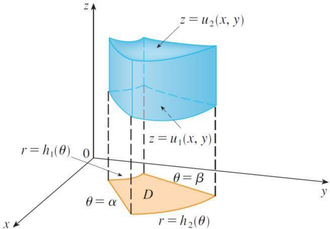
Figure 11.8 Type I region

Figure 11.8 Type I region

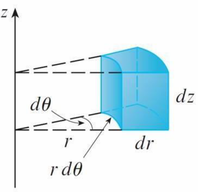
Suppose that E is a type 1 region whose projection D onto the xy-plane is conveniently described in polar coordinates (see Figure 11.8). It says that we convert a triple integral from rectangular to cylindrical coordinates by writing x=rcos⁡θx = r\cos\theta, y=rsin⁡θy = r\sin\theta, leaving z as it is, using the appropriate limits of integration for z, r, and θ, and replacing dVdV by r dz dr dθr\,dz\,dr\,d\theta. (Figure 11.9 shows how to remember this.)

Figure 11.9: Volume element in cylindrical coordinates: (r, θ, z)

Figure 11.9: Volume element in cylindrical coordinates: (r, θ, z)

dV=r dz dr dθdV = r\,dz\,dr\,d\theta

Suppose that f is continuous and

E={(x,y,z)∣(x,y)∈D, u1(x,y)≤z≤u2(x,y)}E = \{(x, y, z) \mid (x, y) \in D,\ u_1(x, y) \le z \le u_2(x, y)\}

where D is given in polar coordinates by

D={(r,θ)∣α≤θ≤β, h1(θ)≤r≤h2(θ)}D = \{(r, \theta) \mid \alpha \le \theta \le \beta,\ h_1(\theta) \le r \le h_2(\theta)\}

We know

∭Ef(x,y,z) dV=∬D[∫u1(x,y)u2(x,y)f(x,y,z) dz]dA\iiint_E f(x, y, z)\,dV = \iint_D \left[\int_{u_1(x,y)}^{u_2(x,y)} f(x, y, z)\,dz\right] dA

Hence, to evaluate the triple integral for cylindrical coordinates, we use the following formula:

∭Ef(x,y,z) dz r dr dθ=∫θ=αθ=β∫r=dr=c∫z=az=bf(rcos⁡θ,rsin⁡θ,z) dz r dr dθ\iiint_E f(x, y, z)\,dz\,r\,dr\,d\theta = \int_{\theta=\alpha}^{\theta=\beta}\int_{r=d}^{r=c}\int_{z=a}^{z=b} f(r\cos\theta, r\sin\theta, z)\,dz\,r\,dr\,d\theta

It is worthwhile to use this formula when E is a solid region easily described in cylindrical coordinates, and when function f (x, y, z) involves the expression x2+y2x^2 + y^2.

11.3.2.1 Finding A Cylindrical Volume Using Triple Integral​

Example 11.5​

Find the volume of T: solid bound by x2+y2+z2=9x^2 + y^2 + z^2 = 9 and 8z=x2+y28z = x^2 + y^2

Solution

Steps:

If possible, always solve the dzdz first as we will end up with r dr dθr\,dr\,d\theta (which like double integral).

x2+y2+z2=9—- (1)x^2 + y^2 + z^2 = 9 \quad \text{---- (1)} 8z=x2+y2—- (2)8z = x^2 + y^2 \quad \text{---- (2)}

To determine which Z region is top and bottom of plane is by plug in (0,0) into the eq. (1) and (2).

We'll get z=3z = 3 --- eq. (1) and z=0z = 0 --- eq. (2). Thus, eq. (1) at top and eq. (2) at bottom.

x2+y2+z2=9—- (1)  ⟹  topx^2 + y^2 + z^2 = 9 \quad \text{---- (1)} \implies \text{top} r2+z2=9r^2 + z^2 = 9 z=9−r2z = \sqrt{9 - r^2}

8z=x2+y2—- (2)  ⟹  bottom8z = x^2 + y^2 \quad \text{---- (2)} \implies \text{bottom} 8z=r28z = r^2 z=r2/8z = r^2/8

r28≤z≤9−r2\frac{r^2}{8} \le z \le \sqrt{9 - r^2}

Then, we find r by finding the intersection.

eq. (1) – eq. (2)

z2+8z−9=0z^2 + 8z - 9 = 0

z = -9 and 1 (we only consider the +ve value)

When z = 1

8(1)=x2+y28(1) = x^2 + y^2 x2+y2=r2  ⟹  r=22x^2 + y^2 = r^2 \implies r = 2\sqrt{2}

Circle of radius 2√2 in the xy-plane

Set up the integral:

∫θ=0θ=2π∫r=0r=22∫z=x2+y28z=9−x2−y21 dz r dr dθ\int_{\theta=0}^{\theta=2\pi}\int_{r=0}^{r=2\sqrt{2}}\int_{z=\frac{x^2+y^2}{8}}^{z=\sqrt{9-x^2-y^2}} 1\,dz\,r\,dr\,d\theta

Answer: 40π3\dfrac{40\pi}{3}

Example 11.6​

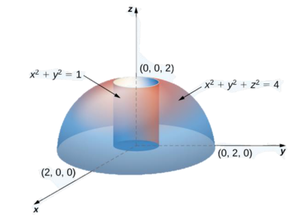
Let E be the region bounded below by the rθ-plane, above by the sphere x2+y2+z2=4x^2 + y^2 + z^2 = 4, and on the sides by the cylinder x2+y2=1x^2 + y^2 = 1. Set up a triple integral in cylindrical coordinates to find the volume of the region

Solution

Region inside the cylinder x² + y² = 1 and below the sphere x² + y² + z² = 4

Solve the dzdz first

Use the equation of sphere to find z:

x2+y2+z2=4  ⟹  z=4−x2−y2=4−r2x^2 + y^2 + z^2 = 4 \implies z = \sqrt{4 - x^2 - y^2} = \sqrt{4 - r^2}

Hence, 0≤z≤4−r20 \le z \le \sqrt{4 - r^2}

The equation of cylinder: x2+y2=12  ⟹  x2+y2=r2x^2 + y^2 = 1^2 \implies x^2 + y^2 = r^2, r = 1

Hence, 0≤r≤10 \le r \le 1

Circle of radius 1 in the xy-plane

Set up the integral:

∫θ=0θ=2π∫r=0r=1∫z=0z=4−r21 dz r dr dθ=2π(83−3)\int_{\theta=0}^{\theta=2\pi}\int_{r=0}^{r=1}\int_{z=0}^{z=\sqrt{4-r^2}} 1\,dz\,r\,dr\,d\theta = 2\pi\left(\frac{8}{3} - \sqrt{3}\right)

11.3.3 Triple Integral in Spherical Coordinates​

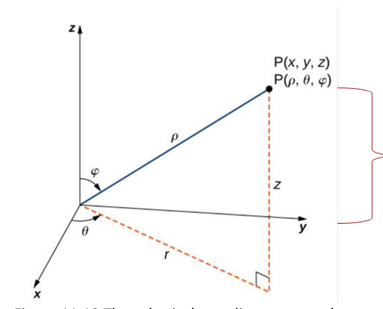
In three-dimensional space R-3 in the spherical coordinate system, we specify a point P by its distance ρ from the origin, the polar angle θ from the positive x-axis (same as in the cylindrical coordinate system), and the angle φ from the positive z-axis and the line OP.

Figure 11.10 The spherical coordinate system locates points with two angles and a distance from the origin.

Figure 11.10 The spherical coordinate system locates points with two angles and a distance from the origin.

Because this is spherical coordinate, we must translate in terms of ρ, φ, θ.

Where,

sin⁡φ=rρ,r=ρsin⁡φ\sin\varphi = \frac{r}{\rho},\quad r = \rho\sin\varphi

Thus.

x=rcos⁡θ  ⟹  ρsin⁡φcos⁡θx = r\cos\theta \implies \rho\sin\varphi\cos\theta y=rsin⁡θ  ⟹  ρsin⁡φsin⁡θy = r\sin\theta \implies \rho\sin\varphi\sin\theta

What about z?

z=ρcos⁡φz = \rho\cos\varphi

* Spherical coordinate systems work well for solids that are symmetric around a point, such as spheres and cones.

Notes:

The definition for r and θ is the same as cylindrical coordinates. However, for spherical coordinates there are two additional symbols (ρ and φ).

It is very important to remember

cylindrical coordinate: (r, θ, z)

spherical coordinate: (ρ, θ, φ)

(ρ ≥ 0, 0 ≤ θ ≤ 2π, 0 ≤ φ ≤ π)

Cylindrical equation: x2+y2=r2x^2 + y^2 = r^2

Spherical equation: x2+y2+z2=ρ2x^2 + y^2 + z^2 = \rho^2

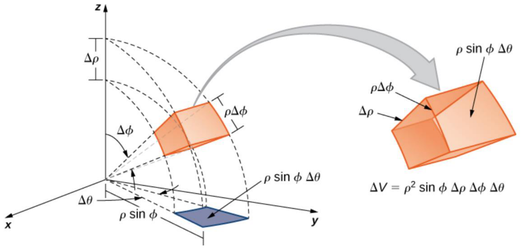
We now establish a triple integral in the spherical coordinate system, as we did before in the cylindrical coordinate system. For the volume element of the subbox ΔV\Delta V in spherical coordinates, we have ΔV=(Δρ)(ρΔφ)(ρsin⁡φΔθ)\Delta V = (\Delta\rho)(\rho\Delta\varphi)(\rho\sin\varphi\Delta\theta), as shown in the following Figure 11.11.

Figure 11.11 The volume element of a box in spherical coordinates

Figure 11.11 The volume element of a box in spherical coordinates

We know

∭Ef(x,y,z) dV=∬D[∫u1(x,y)u2(x,y)f(x,y,z) dz]dA\iiint_E f(x, y, z)\,dV = \iint_D \left[\int_{u_1(x,y)}^{u_2(x,y)} f(x, y, z)\,dz\right] dA

Hence, to evaluate the triple integral for spherical coordinates, we use the following formula:

x=rcos⁡θ  ⟹  ρsin⁡φcos⁡θ,y=rsin⁡θ  ⟹  ρsin⁡φsin⁡θ,and r=ρsin⁡φ,x = r\cos\theta \implies \rho\sin\varphi\cos\theta,\quad y = r\sin\theta \implies \rho\sin\varphi\sin\theta,\quad \text{and } r = \rho\sin\varphi, Where, spherical coordinate: (ρ, θ, φ) and dV=ρ2sin⁡φ dρ dθ dφdV = \rho^2\sin\varphi\,d\rho\,d\theta\,d\varphi

∭Ef(x,y,z) dV=∭Tf(ρ,θ,φ) ρ2sin⁡φ dρ dφ dθ\iiint_E f(x, y, z)\,dV = \iiint_T f(\rho, \theta, \varphi)\,\rho^2\sin\varphi\,d\rho\,d\varphi\,d\theta

∭Tf(ρ,θ,φ) ρ2sin⁡φ dρ dφ dθ=∫θ=αθ=β∫φ=φ1φ=φ2∫ρ=aρ=bf(ρ,θ,φ) ρ2sin⁡φ dρ dφ dθ\iiint_T f(\rho, \theta, \varphi)\,\rho^2\sin\varphi\,d\rho\,d\varphi\,d\theta = \int_{\theta=\alpha}^{\theta=\beta}\int_{\varphi=\varphi_1}^{\varphi=\varphi_2}\int_{\rho=a}^{\rho=b} f(\rho, \theta, \varphi)\,\rho^2\sin\varphi\,d\rho\,d\varphi\,d\theta

11.3.3.1 Finding A Spherical Volume Using Triple Integral​

Example 11.7​

∭Tx2+y2+z2 dV\iiint_T \sqrt{x^2 + y^2 + z^2}\,dV, The region 'T' is sphere with equation of x2+y2+z2=1x^2 + y^2 + z^2 = 1

Solution

For spherical coordinates, always solve dρd\rho first.

x2+y2+z2=ρ2x^2 + y^2 + z^2 = \rho^2 x2+y2+z2=1x^2 + y^2 + z^2 = 1

Hence, ρ=±1\rho = \pm 1, we only consider positive value

Remember: ρ≥0\rho \ge 0, 0≤θ≤2π0 \le \theta \le 2\pi, 0≤φ≤π0 \le \varphi \le \pi

Then, solve dφd\varphi, set x=0x = 0, Remember, φ always on yz-plane. Then, we will get

0+y2+z2=10 + y^2 + z^2 = 1

Circle y² + z² = 1 in the yz-plane

0≤φ≤π0 \le \varphi \le \pi

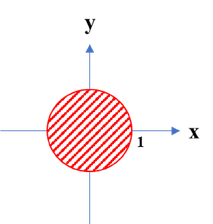
Although it can form 2π, the φ is never more than π

Next, solve dθd\theta by setting z=0z = 0. Remember θ always on xy-plane   ⟹  \implies we will get y2+x2=1y^2 + x^2 = 1

Circle y² + x² = 1 in the xy-plane

0≤θ≤2π0 \le \theta \le 2\pi

Set up the integral:

∫θ=0θ=2π∫φ=0φ=π∫ρ=0ρ=1x2+y2+z2 ρ2sin⁡φ dρ dφ dθ\int_{\theta=0}^{\theta=2\pi}\int_{\varphi=0}^{\varphi=\pi}\int_{\rho=0}^{\rho=1} \sqrt{x^2 + y^2 + z^2}\,\rho^2\sin\varphi\,d\rho\,d\varphi\,d\theta

∫θ=0θ=2π∫φ=0φ=π∫ρ=0ρ=1ρ2 ρ2sin⁡φ dρ dφ dθ=∫θ=0θ=2π∫φ=0φ=π∫ρ=0ρ=1ρ3sin⁡φ dρ dφ dθ=π\int_{\theta=0}^{\theta=2\pi}\int_{\varphi=0}^{\varphi=\pi}\int_{\rho=0}^{\rho=1} \sqrt{\rho^2}\,\rho^2\sin\varphi\,d\rho\,d\varphi\,d\theta = \int_{\theta=0}^{\theta=2\pi}\int_{\varphi=0}^{\varphi=\pi}\int_{\rho=0}^{\rho=1} \rho^3\sin\varphi\,d\rho\,d\varphi\,d\theta = \pi

Example 11.8​

∭Txz dV\iiint_T xz\,dV, The region 'T' is solid bound by x2+y2+z2=4x^2 + y^2 + z^2 = 4 and z=x2+y2z = \sqrt{x^2 + y^2}

Solution

Observe the given equation if the question did not stated type of geometrical shape.

In this question:

x2+y2+z2=4  ⟹  spherical shapex^2 + y^2 + z^2 = 4 \implies \text{spherical shape} z=x2+y2  ⟹  cone shapez = \sqrt{x^2 + y^2} \implies \text{cone shape}

Ice cream cone shape: the solid inside the sphere and above the cone

For spherical coordinates, always solve dρd\rho first.

x2+y2+z2=ρ2x^2 + y^2 + z^2 = \rho^2 x2+y2+z2=4x^2 + y^2 + z^2 = 4 ρ=2\rho = 2

0≤ρ≤20 \le \rho \le 2

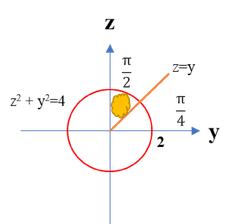
Then, to solve dφd\varphi, set x=0x = 0, we will get y2+z2=4y^2 + z^2 = 4 (from the spherical, it gives us circle equation) and z=y2z = \sqrt{y^2} (from the cone, it gives us line equation)

Circle z² + y² = 4 with the line z = y in the zy-plane

Although it can form π, the geometry for the region 'T' is ice cream cone shape which involved only the upper half cylinder and a cone. Hence, the φ is:

π4≤φ≤π2\frac{\pi}{4} \le \varphi \le \frac{\pi}{2}

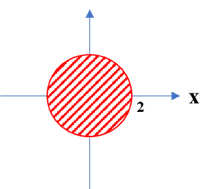
Next, solve dθd\theta by setting z=0z = 0. Remember θ always on xy-plane   ⟹  \implies we will get x2+y2=4x^2 + y^2 = 4

Circle x² + y² = 4 in the xy-plane

0≤θ≤2π0 \le \theta \le 2\pi

Set up the integral:

∫θ=0θ=2π∫φ=π4φ=π2∫ρ=0ρ=2xz ρ2sin⁡φ dρ dφ dθ=∫θ=0θ=2π∫φ=π4φ=π2∫ρ=0ρ=2ρsin⁡φcos⁡θ ρcos⁡φ ρ2sin⁡φ dρ dφ dθ\int_{\theta=0}^{\theta=2\pi}\int_{\varphi=\frac{\pi}{4}}^{\varphi=\frac{\pi}{2}}\int_{\rho=0}^{\rho=2} xz\,\rho^2\sin\varphi\,d\rho\,d\varphi\,d\theta = \int_{\theta=0}^{\theta=2\pi}\int_{\varphi=\frac{\pi}{4}}^{\varphi=\frac{\pi}{2}}\int_{\rho=0}^{\rho=2} \rho\sin\varphi\cos\theta\,\rho\cos\varphi\,\rho^2\sin\varphi\,d\rho\,d\varphi\,d\theta

For this equation, you will end up with

∫θ=0θ=2π∫φ=π4φ=π2∫ρ=0ρ=2ρsin⁡φcos⁡θ ρcos⁡φ ρ2sin⁡φ dρ dφ dθ=0\int_{\theta=0}^{\theta=2\pi}\int_{\varphi=\frac{\pi}{4}}^{\varphi=\frac{\pi}{2}}\int_{\rho=0}^{\rho=2} \rho\sin\varphi\cos\theta\,\rho\cos\varphi\,\rho^2\sin\varphi\,d\rho\,d\varphi\,d\theta = 0

Tips: if you end up with zero for polar coordinate question, try to change the ∫θ=0θ=2π\int_{\theta=0}^{\theta=2\pi} to 2∫θ=0θ=π2\int_{\theta=0}^{\theta=\pi} OR 4∫θ=0θ=π24\int_{\theta=0}^{\theta=\frac{\pi}{2}} OR etc.

11.3.4 Application of Triple Integral Using Polar Coordinates to Find​

11.3.4.1 Centre of Mass​

The expressions for the centre of mass (xˉ,yˉ,zˉ)(\bar{x}, \bar{y}, \bar{z}) of a solid of density ρ(x,y,z)\rho(x, y, z) are given below

xˉ=∫ρ(x,y,z) x dV∫ρ(x,y,z) dV=MyzM\bar{x} = \frac{\int \rho(x,y,z)\,x\,dV}{\int \rho(x,y,z)\,dV} = \frac{M_{yz}}{M}

yˉ=∫ρ(x,y,z) y dV∫ρ(x,y,z) dV=MxzM\bar{y} = \frac{\int \rho(x,y,z)\,y\,dV}{\int \rho(x,y,z)\,dV} = \frac{M_{xz}}{M}

zˉ=∫ρ(x,y,z) z dV∫ρ(x,y,z) dV=MxyM\bar{z} = \frac{\int \rho(x,y,z)\,z\,dV}{\int \rho(x,y,z)\,dV} = \frac{M_{xy}}{M}

Where

M=∭Tρ(x,y,z) dV=∭Tρ(x,y,z) dz r dr dθM = \iiint_T \rho(x, y, z)\,dV = \iiint_T \rho(x, y, z)\,dz\,r\,dr\,d\theta

If ρ\rho does not vary with position, these simplify to

xˉ=∫x dV∫dVyˉ=∫y dV∫dVzˉ=∫z dV∫dV\bar{x} = \frac{\int x\,dV}{\int dV} \qquad \bar{y} = \frac{\int y\,dV}{\int dV} \qquad \bar{z} = \frac{\int z\,dV}{\int dV}

Example 11.9​

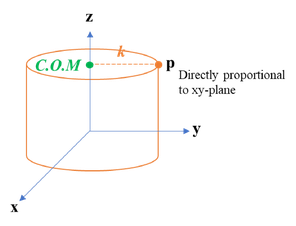
Find centre of mass of solid bound by x2+y2=4x^2 + y^2 = 4, z=0z = 0, z=3z = 3, where the mass density at a point is directly proportional to the point distance from xy-plane.

Solution

Point P at height k above the xy-plane

Mass density,

ρ(x,y,z)=k⋅z\rho(x, y, z) = k\cdot z

x2+y2=4x^2 + y^2 = 4 is a circle equation and the geometrical shape is cylindrical

Hence, we need to find r, θ, z

The dzdz has been solved where question gave us z=0z = 0 and z=3z = 3

Then, find r,

x2+y2=4, r=2x^2 + y^2 = 4,\ r = 2

Circle of radius 2 in the xy-plane

0≤r≤20 \le r \le 2 0≤θ≤2π0 \le \theta \le 2\pi

Set up the integral

M=∭Tρ(x,y,z) dV=∭Tρ(x,y,z) dz r dr dθM = \iiint_T \rho(x, y, z)\,dV = \iiint_T \rho(x, y, z)\,dz\,r\,dr\,d\theta

M=∫θ=0θ=2π∫r=0r=2∫z=0z=3k⋅z dz r dr dθ=18kπM = \int_{\theta=0}^{\theta=2\pi}\int_{r=0}^{r=2}\int_{z=0}^{z=3} k\cdot z\,dz\,r\,dr\,d\theta = 18k\pi

In this question, the centre of mass for the mass density at a point is directly proportional to the distance from xy-plane. Hence, the centre of mass for xˉ\bar{x} and yˉ\bar{y} is 0. Thus, we only need to find the zˉ\bar{z}.

Cylinder with centre of mass marked on the z-axis

Mxy=∫θ=0θ=2π∫r=0r=2∫z=0z=3z⋅k⋅z dz r dr dθ=36kπM_{xy} = \int_{\theta=0}^{\theta=2\pi}\int_{r=0}^{r=2}\int_{z=0}^{z=3} z\cdot k\cdot z\,dz\,r\,dr\,d\theta = 36k\pi

zˉ=36kπ18kπ=2\bar{z} = \frac{36k\pi}{18k\pi} = 2

The centre of mass (C.O.M) = (0,0,2)

11.3.4.2 Moment of Inertia​

Recall back section 10.4.2 (moment of inertia)

The moment of inertia II of a small particle of mass mm is defined as

I=Mass×Distance2orI=md2I = \text{Mass} \times \text{Distance}^2 \quad \text{or} \quad I = md^2

where dd is the perpendicular distance from the particle to the axis.

To find the Moment of Inertia of a larger object, it is necessary to carry out a volume integration over all such particles. The distance of a particle at (x,y,z)(x, y, z) from the z-axis is given by x2+y2\sqrt{x^2 + y^2} so the moment of inertia of an object about the zz-axis is given by

Iz=∫Vρ(x,y,z)(x2+y2) dVI_z = \int_V \rho(x, y, z)(x^2 + y^2)\,dV

Similarly, the Moments of Inertia about the xx- and yy-axes are given by
Ix=∫Vρ(x,y,z)(z2+y2) dVI_x = \int_V \rho(x, y, z)(z^2 + y^2)\,dV Iy=∫Vρ(x,y,z)(x2+z2) dVI_y = \int_V \rho(x, y, z)(x^2 + z^2)\,dV

Example 11.10​

Find the moment of inertia of a uniform sphere of mass M and radius a about a diameter.

Solution

A sphere of radius aa has volume 4πa3/34\pi a^3/3, so that its density is 3M/4πa33M/4\pi a^3. Then the moment of inertia of the sphere about the zz axis is

I=3M4πa3∭V(x2+y2) dx dy dzI = \frac{3M}{4\pi a^3}\iiint_V (x^2 + y^2)\,dx\,dy\,dz

In this example it is natural to use spherical polar coordinates (recall that x=rsin⁡θcos⁡ϕx = r\sin\theta\cos\phi, y=rsin⁡θsin⁡ϕy = r\sin\theta\sin\phi, z=rcos⁡θz = r\cos\theta and dx dy dz=r2sin⁡θ dr dθ dϕdx\,dy\,dz = r^2\sin\theta\,dr\,d\theta\,d\phi), so that

I=3M4πa3∭V(r2sin⁡2θcos⁡2ϕ+r2sin⁡2θsin⁡2ϕ) r2sin⁡θ dϕ dθ drI = \frac{3M}{4\pi a^3}\iiint_V (r^2\sin^2\theta\cos^2\phi + r^2\sin^2\theta\sin^2\phi)\,r^2\sin\theta\,d\phi\,d\theta\,dr

=3M4πa3∭V(r2sin⁡2θ) r2sin⁡θ dϕ dθ dr= \frac{3M}{4\pi a^3}\iiint_V (r^2\sin^2\theta)\,r^2\sin\theta\,d\phi\,d\theta\,dr

=3M4πa3∫r=0a∫θ=0π∫ϕ=02πr4sin⁡3θ dϕ dθ dr= \frac{3M}{4\pi a^3}\int_{r=0}^{a}\int_{\theta=0}^{\pi}\int_{\phi=0}^{2\pi} r^4\sin^3\theta\,d\phi\,d\theta\,dr

=3M4πa3∫r=0ar4 dr∫θ=0πsin⁡3θ dθ∫ϕ=02πdϕ= \frac{3M}{4\pi a^3}\int_{r=0}^{a} r^4\,dr \int_{\theta=0}^{\pi}\sin^3\theta\,d\theta \int_{\phi=0}^{2\pi} d\phi

=3M4πa3[15r5]r=0a[112cos⁡3θ−34cos⁡θ]θ=0π[ϕ]ϕ=02π= \frac{3M}{4\pi a^3}\left[\frac{1}{5}r^5\right]_{r=0}^{a}\left[\frac{1}{12}\cos 3\theta - \frac{3}{4}\cos\theta\right]_{\theta=0}^{\pi}\left[\phi\right]_{\phi=0}^{2\pi}

=3M4πa3(815πa5)= \frac{3M}{4\pi a^3}\left(\frac{8}{15}\pi a^5\right)

=25Ma2.■= \frac{2}{5}Ma^2. \qquad \blacksquare