(iii) Let a=⟨2,−1⟩ and b=⟨−1/2,1/4⟩. Determine if the following vectors are parallel, orthogonal or neither.
Projection of vector
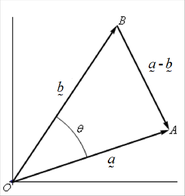
Let a and b be two nonzero vectors and let a^ be the unit vector in the direction of a.
Then the projection of b onto a is defined as b.a^=b.∣a∣a
The component of b in the direction of a is defined as (b.a^)a^
Geometric Interpretation
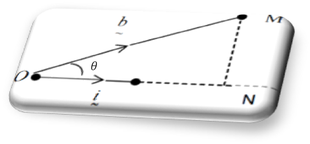
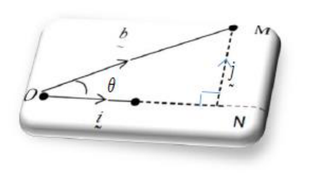
Let the angle between the vectors b and i be θ
The projection of b onto i
Then, the projection of b onto i=b.i^
=∣b∣∣i^∣cosθ
=∣b∣cosθ∵∣i^∣=1
=ON = the length of the orthogonal projection of b on a straight line parallel to i^
The component of b in the direction of i, (b.i^)i^
=(∣b∣cosθ)i∵i^=i (both also unit vector)
=ON
Note:ON is parallel to i. The projection of b onto i takes the negative sign if ON is in the opposite direction of i and vice versa.
The projection of b onto a
The projection of b onto a when the projection points the other way
Theorem
If a is a given vector, then any vector b (i.e., b=b1+b2) can be expressed as the sum of a vector parallel to a (i.e., b1∥a) and a vector perpendicular to a (i.e., b2⊥a).
b resolved into a component parallel to a and a component perpendicular to a
The triangle OMN used in the proof
Proof
From the diagram, OM=ON+NM ------------------ (a)
Previously we got ON=(b.i^)i^ for projection of vector b onto vector i
In this case, ON=(b.a^)a^ for projection of vector b onto vector a
We can use dot product to find the line equation and extend it to plane equation. Besides, we will use it to find distance between point-line, point-plane, parallel-lines, parallel-planes. Furthermore, we can use it to find angles between intersecting lines and intersection planes.
(a) The equation of line (2D) and plane (3D) perpendicular to a given vector
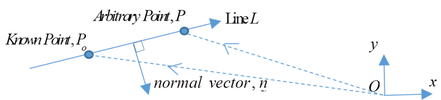
Let L be a line passing through to the point P0(x0,y0) and perpendicular to the vector n=ai+bj. Let P(x,y) be any point on the line L.
The line L through P0 with normal vector n
Then the vector P0P is along the line L and hence P0P⊥n
So, (P0P).n>>(OP−OP0).n>>{(xi+yj)−(x0i+y0j)}.(ai+bj)>>a(x−x0)+b(y−y0)>>ax+by>>ax+by=0=0or(p−p0).n=0=0=0=ax0+by0=c, where c=ax0+by0 is a scalar.
This is known as Cartesian equation of the line L (for 2D space use only).
Note: The components of n are the coefficients of the line equation, a and b. From the Cartesian equation, we can know the information of the vector normal to the line, n.
Additional remarks: Note that the Cartesian equation of line L is restricted for plotting 2D line only. We need to use Vector or Parametric Eqn. of line L learned in Section 4.1.3 for both 2D and 3D line plotting purpose.
(i) Problems of 2D line in Cartesian form
(ii) Problems of 3D plane in Cartesian form
1. Find the Cartesian equation of a line passing through a given point and normal to a given vector.
1. Find the Cartesian equation of a plane passing through a given point and normal to a given vector.
2. Find the distance from a point to a line.
2. Find the distance from a point to a plane.
3. Find the distance between two parallel lines.
3. Find the distance between two parallel planes.
4. Find the angle between two intersecting lines.
4. Find the angle between two intersecting planes.
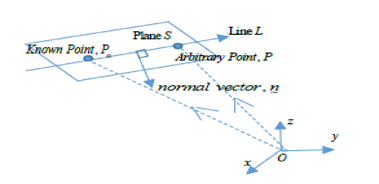
Let S be a plane passing through to the point P0(x0,y0,z0) and normal to the vector n=ai+bj+ck. Let P(x,y,z) be any point in the plane S.
Then the vector P0P is in the plane S and hence P0P⊥n.
The plane S through P0 with normal vector n
So, (P0P).n>>(OP−OP0).n>>{(xi+yj+zk)−(x0i+y0j+z0k)}.(ai+bj+ck)>>a(x−x0)+b(y−y0)+c(z−z0)>>ax+by+cz>>ax+by+cz=0=0or(p−p0).n=0=0=0=ax0+by0+cz0=d, where d=ax0+by0+cz0 is a scalar.
This is known as Cartesian/plane equation of the plane S.
Note: the components of n are the coefficients of the plane equation, a, b and c. From the Cartesian/plane equation, we can know the information of the vector normal to the line, n.
Precaution: You might think single equation such as ax + by + cz = d would be the general equation of a line in 3 dimensions. However, such an equation defines a plane in R3, which geometrically is a flat surface which carries on forever in the space.
Orthogonal vectors in 2D space
Orthogonal vectors in 3D space
In 2 dimensions the orthogonal vector is unique and forms a unique 2D line.
In 3 dimensions, a vector has infinitely many orthogonal vectors, which sweep out around it forming a plane.
Think: So how is a line defined in 3 dimensions? You will learn this after knowing the cross product.
Exercise:
(i) Find the Cartesian equation of the line L in the plane passing through the point A(2,3) and perpendicular to the vector n=i−3j
(ii) Find the Cartesian equation of the plane S passing through the point A(1,1,−1) and normal to the vector n=−2i+2j−5k
(b) The Distance from a Point to a Line or to a Plane
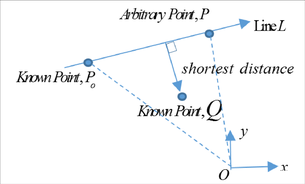
Let L be a line with the Cartesian equation ax+by=c and let P be a point on the line L. From the Cartesian equation of the line L, the vector n=ai+bj is perpendicular to L.
Distance from the point Q to the line L
Previously you learnt the projection of b onto a is defined as b.a^=b.∣a∣a
Thus, distance of point Q to the line L = projection of the vector PQ onto the vector n
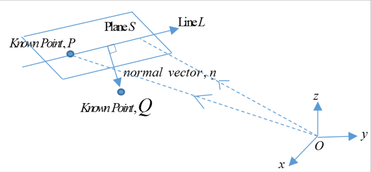
Let S be a plane with the equation ax+by+cz=d and let P be a point on the plane S. From the Cartesian equation of the plane S, the vector n=ai+bj+ck is normal to S.
Then, the distance from the point Q to the plane S is the projection of the vector PQ onto the vector n.
Distance point Q to the plane S
=PQ.n^=PQ.∣n∣n
Distance from the point Q to the plane S
Exercise:
(i) Find the distance from the point Q(4,4) to the line L:x+3y=6
(ii) Find the distance from the point Q(3,2,−1) to the plane S:−2x+3y−z=2
(c) Distance between two parallel lines or two parallel planes
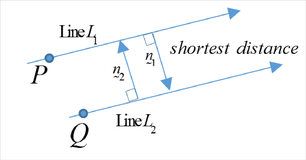
The projection method is also used to find the distance between two parallel lines L1 and L2. Let us choose one point P from the line L1 and another point Q from the line L2.
For two parallel lines, the perpendicular vectors, n1 and n2 for lines L1 and L2 are equal: n1=n2=n.
Distance between parallel lines L1 and L2=PQ.∣n∣n
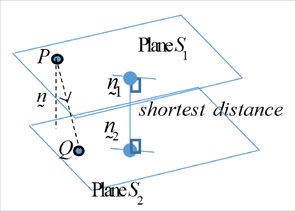
The projection method is also used to find the distance between two parallel planes S1 and S2. Let us choose one point P from the plane S1 and another point Q from the plane S2.
For two parallel planes, the perpendicular vectors, n1 and n2 for planes S1 and S2 are equal: n1=n2=n.
Distance between parallel planes S1 and S2=PQ.∣n∣n
Distance between two parallel planes
Exercise:
(i) Find the distance between line L1:x+3y=−2 to the line L2:x+3y=6
(ii) Find the distance between plane S1:−2x+3y−z=2 to the plane S2:2x−3y+z=−15
(iii) Find the constant distance between plane S1:−2x−3y−z=2 to the plane S2:−2x+3y−z=15 if exist/possible.
(d) Find the angle between two intersecting lines or two intersecting planes
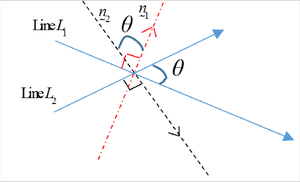
Let L1 and L2 be two lines with the perpendicular vectors, n1 and n2, respectively. If L1 and L2 intersect, then the angle between L1 and L2 is equal to angle between n1 and n2.
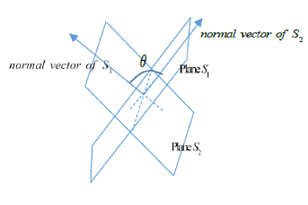
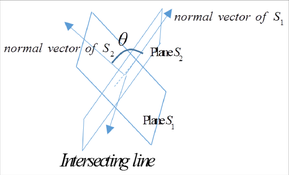
Let S1 and S2 be two planes with the perpendicular vectors, n1 and n2, respectively. If S1 and S2 intersect, then the angle between S1 and S2 is equal to angle between n1 and n2.
Therefore, n1.n2=∣n1∣∣n2∣cosθ
θ=cos−1∣n1∣∣n2∣n1.n2
Angle between two intersecting planes
Exercise:
(i) Find the angle between the lines L1:3x−6y=15 and L2:2x+y=5
(ii) Find the angle between the planes S1:3x−6y−2z=15 and S2:2x+y−2z=5
4.1.3 Application in geometry: Equations of lines in 2D and 3D spaces
Problems in space (in 2D and 3D space)
Find the equation of a line passing through a given point and parallel to a given vector (all in 2D & 3D space).
Determine whether two lines intersect in three dimension space and find the point of intersection if they intersect.
(i) Definition (Equation of a line in 2D or 3D space)
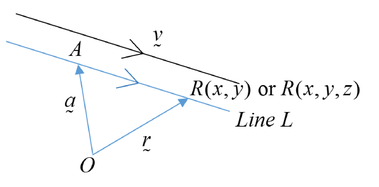
Let L be a straight line passing through the point A and is parallel to a given vector v (i.e., AR∥v). Suppose that R(x,y) or R(x,y,z) is any point on L. Find the vector equation, parametric equation and Cartesian equation of line L.
The line L through A parallel to the direction vector v
(i) Let (OA)=a and (OR)=r be the position vectors of A and R respectively.
(ii) Since (AR∥v), then (AR)=tv, where t∈R.
Note: as t changes, we have all the points on the line L.
(iii) Now following head-to-tail method, OR=OA+AR
Then, we get r=a+tv ----------------------------------------------------------------- (1)
This is called the vector equation of the line L.
The vector v is called a direction vector of the line L.
Note: The Eqn. (1) can be applied for problem in 2D or 3D space. Since the computation and derivation for 2D and 3D space are similar. We will give the example in 3D one for the demonstration.
(b) Parametric equation of a line in 2D and 3D space
Now, let position vector of an arbitrary point on line L, r=xi+yj+zk, position vector of a point passing through line L, a=a1i+a2j+a3k and direction vector parallel to line L, v=v1i+v2j+v3k
From Eqn. (1) we have
r=a+tv>>⟨x,y,z⟩=⟨a1,a2,a3⟩+t⟨v1,v2,v3⟩
>>Point at time txyz=Initial Pointa1a2a3+tDirection Vectorv1v2v3(Matrix form of vector equation of line)
By comparing the components of i, j, and k, we have
r=⟨x,y,z⟩
xyz=a1+tv1=a2+tv2=a3+tv3⎭⎬⎫,t∈R... (2)
This system of equations (2) is called the parametric equations of the line L.
The variable/scalar t is called the parameter of the system of equations.
Note: The Eqn. (2) can be applied for problem in 2D or 3D space in the same manner.
(c) Cartesian equation of a line in 2D and 3D space
By equal the parameter t in the Eq. (2), we have
t=v1x−a1=v2y−a2=v3z−a3... (3)
The Eqn. (3) is called the Cartesian equation or symmetric form of the line L.
Precaution Zero denominator leads to zero numerator as shown in Eqn. (3).
Proof: From Eqn. (2), if v1=0, then x−a1=0. This also apply to v2 and v3.
(ii) Intersection between a line to a plane or between two lines
If we know the information of a plane and the line equation are given either in format of Vector Eqn./Parametric Eqn./Cartesian Eqn., for example:
Information of a plane
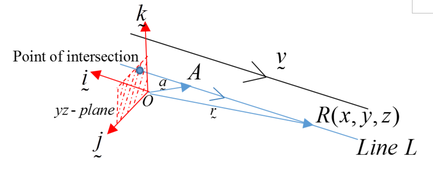
(i) The line intersects at a specific plane, i.e., yz-plane at coordinate (x,y,z)=(0,y,z)
A line intersecting the yz-plane
Let say Parametric Eqn. have been derived from a given information of point A passing through the line, and the vector direction of the line L, v are given as well. Then, we can use Parametric Eqn.
xyz=a1+tv1=a2+tv2=a3+tv3⎭⎬⎫,t∈Rto solve for t,y and z.
Then the point of intersection at yz-plane, (0,y,z) can be obtained.
(ii) The plane of eqn. of the intersection plane is given, i.e., ax+by+cz=k
The step is similar to procedure above. Given the a, b, c and k, substitute the Parametric Eqn. into the eqn. of intersection to solve for t. Then, you can get the point of intersection (x,y,z) by substitute t into Parametric Eqn.
Precaution: There are three possibilities of the intersection: (i) line intersects the plane in a point; (ii) line is parallel to the plane (no point of intersection); (iii) line is in the plane.
Note: You will know how to derive the equation of plane after you learn about product of vectors.
Let us have line L1:r1=⟨x1,y1,z1⟩=⟨a1,a2,a3⟩+t⟨v1,v2,v3⟩ and line L2:r2=⟨x2,y2,z2⟩=⟨b1,b2,b3⟩+s⟨u1,u2,u3⟩ where t and s are the parameters, a=⟨a1,a2,a3⟩, b=⟨b1,b2,b3⟩ are the position vectors specified at line L1 and L2 respectively. v=⟨v1,v2,v3⟩, u=⟨u1,u2,u3⟩ are the vectors parallel to line L1 and L2.
If the line L1 and line L2 intersect each other, then:
This means that all the three Eqns. (a), (b) and (c) must be satisfied if the two lines L1 and L2 are intersecting with each other. In the other words, if the parameter t obtained from Eqn. (a) and parameter s obtained from Eqn. (b) will not satisfy Eqn.(c) if there is no point of intersection.
It intersection exist, the point of intersection is as following:
(x1=x2,y1=y2,z1=z2) or ((a1+tv1),(a2+tv2),(a3+tv3)) or (b1+su1,b2+su2,b3+su3).
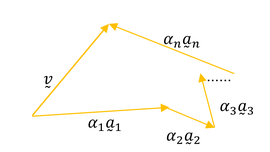
A linear combination of two or more vectors is the vector obtained by adding two or more vectors (with different directions) which are multiplied by scalar values.
A vector v as a linear combination of a1, a2, a3 up to an
Vectors are linearly dependent if there is a linear combination of them that equals the zero vector, without the coefficients of the linear combination being zero.
Note: The vectors are linearly independent if the determinant of the matrix is non-zero, meaning that the rank of the matrix is equal to its full rank.
(Hint: In a matrix system, non-zero determinant helps to indicate a unique solution system)
Let a and b be two vectors and let α be a scalar. Then
i. a×b=−b×a (Anti-commutative Law)
ii. a×(b+c)=(a×b)+(a×c) (Distributive Law)
iii. α(a×b)=(αa)×b=a×(αb) where α is a scalar
iv. The cross product of two vectors (i.e., a×b) is a vector.
Precaution: The cross product cannot function between scalar and vector (i.e., 3×b or (a.b)×c or (a.b).(c.d)×(e))
(c) Orthogonal vector (Also known as perpendicular or normal vector)
We have cross product, a×b=∣a∣∣b∣sinθn, orthogonal vector has a×b=∣a∣∣b∣n
To let a×b=∣a∣∣b∣n, we need to have θ=90∘; sinθ=1
(i) a and b are orthogonal vectors (a⊥b)
(ii) Cross product of unit vector a^×b^=∣a^∣∣b^∣n=n (where mag. of unit vector = 1)
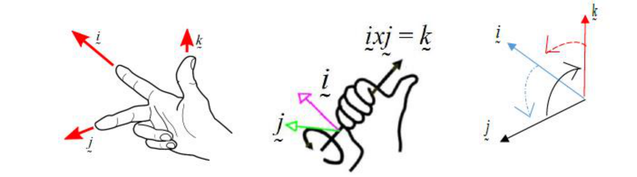
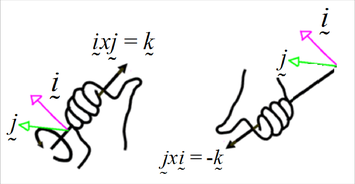
i.e., in the 3D system, i,j,k are unit vectors where i⊥j, j⊥k, i⊥k, therefore the cross product between them are the vector normal to its plane (i.e., i×j=k ; j×k=i and k×i=j). This follows right hand rule and system as following:
The right hand rule for i cross j equals k
Precaution: The cross product of vectors does not satisfy the commutative law: a×b=b×a
=NM = the length of the orthogonal projection of b on a straight line perpendicular to i^
The component of b in the direction of j, (b.j^)j^
=(∣b∣sinθ)j∵j^=j (both also unit vector) ---------------------------------------------------- (2)
=NM
Now we look at the cross product of a vector and a unit vector, then we check its magnitude:
Cross product, b×i^=scalar∣b∣∣i^∣sinθn
Precaution: The normal vector, n is not j. You will learn the component of b in the direction of j using cross product after you learn the triple vector product later.
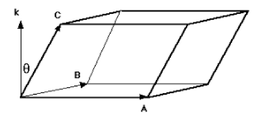
Relationship – Area of Parallelogram & Cross Product
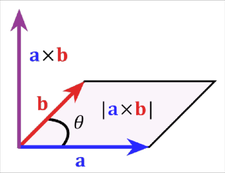
From cross product of vector a and b, we have
a×b=scalar∣a∣∣b∣sinθn
The magnitude of the cross product is
∣a×b∣=∣a∣∣b∣sinθ————————————————– (2)
The magnitude of the cross product equals the area of the parallelogram
Note: Eqn. (1) = Eqn. (2) denotes that the magnitude of cross product is equal to the area of its area of parallelogram.
Area of parallelogram = Height of parallelogram x Length = ∣a∣∣b∣sinθ=∣a×b∣ ----------------- (3)
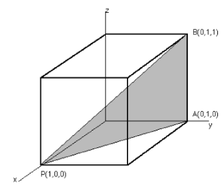
Area of triangle = 21× Height of parallelogram x Length = 21∣a×b∣ --------------------------------- (4)
Exercise:
(ii) Let P(1,−1,0), Q(2,1,−1), and R(−1,1,2) be three points.
Find (a) a vector normal the plane containing P, Q and R
(b) the area of the triangle P, Q and R.
4.1.5 Application of Cross Product in Geometry (given Parallel Vector)
Previous dot product applications are used mainly when the normal vector is given. When the parallel vector is given, we can use the cross product to find the 3D-line equation between intersecting planes, distance between point-to-3D-line, distance between two 3D-parallel-lines, and distance between two 3D-skew-lines.
(i) Previous Problems of 2D line in general Cartesian form
(ii) Current Problems of 3D line in Parametric form
1. Find the general Cartesian equation of a line passing through a given point and normal to a given vector.
1. Find the parametric equation of a 3D line form by two intersecting planes.
2. Find the distance from a point to a line.
2. Find the distance from a point to 3D line.
3. Find the distance between two parallel lines.
3. Find the distance between two 3D parallel lines.
4. Find constant distance between two skew lines – NOT EXIST!
4. Find the distance between two 3D skew lines.
Recall & Motivation: Previously we learned to define a line of equation of a 2D line using general Cartesian Eqn (involve dot product). Now, we have learned the cross product operation, and this enable you to define a line of equation of a 3D line using Parametric Eqn.
Idea: 3D line if formed where two planes intersect.
Let S1 and S2 be two planes with normal vectors n1 and n2 respectively. If S1 and S2 intersect, then the intersection is a line L. Since L is in both S1 and S2, L is parallel to both S1 and S2, L is normal to both n1 and n2.
Therefore, L∥(n1×n2)
Let P be a point on a line L (i.e. P is in both S1 and S2)
Then the vector equation of L is given by
L:r=OP+t(n1×n2)
The intersecting line of two planes
Exercise:
(i) Find the parametric equations of the intersecting line L of the planes
(ii) Describe the procedure to plot the 3D line L by using the parametric equations obtained in Ans (i) . Can we know the direction of the line L from the plotting by using the parametric equation?
(iii) Generated the general Cartesian eqn. from the Parametric eqn. of 3D line L . What are the major advantage of having general Cartesian line eqn. Can we know the direction of the line L from the plotting by using the general Cartesian equation?
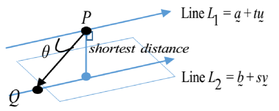
The above method is also used to find the distance between two parallel lines L1 and L2 in space (They have the same direction vector v=u). In this case, we choose one point P from L1 and another point Q from L2.
Distance between two parallel 3D lines
By using projection method and cross method as shown in Section 4.1.4(f), we know the distance from the point Q to the line L.
∣PQ∣sinθ=PQ×∣v∣vorPQ×∣u∣u
Exercise
Find the distance from the two line L1 with the parametric equations: x=1+t, y=3−t, z=2t; and with the vector equation r=⟨5,2,−1⟩+t⟨1,−1,2⟩
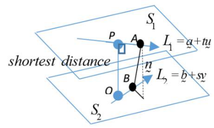
Let L1 and L2 be two skew lines in a 3D space with the vector equations L1:a+tu and L2:b+sv, s,t∈R, respectively.
Let P and Q be the points on L1 and L2, respectively, such that the length of PQ is the shortest distance between the two lines.
From the vector equations, we know that L1∥u and L2∥v. Then, n=u×v is normal to both L1 and L2. Hence, PQ∥n=u×v.
Distance between two 3D skew lines
Let S1 and S2 be the planes that containing L1 and L2, respectively, such that PQ is normal to both planes. Then S1 and S2 are parallel planes. Hence the distance between P and Q is the distance between the two parallel planes S1 and S2.
Therefore, the shortest distance between L1 and L2
=AB.∣n∣n where A and B are the points on L1 and L2, respectively, and, n=u×v is a vector normal to L1 and L2.
∣A×B.n∣=Orthogonal projection of parallelogram with sides A and B onto a plane with unit normal n.
The projection of triangle PAB onto the yz-plane
Find the Area of the projection of triangle PAB onto the yz plane. To do this we use the formula for the area of a projected parallelogram and half the answer to get triangular area instead.