Academic session 2016/2017, Semester 1 · December 2016 / January 2017 · 4 questions · 5 printed pages · 2 hours. Answer all questions. Questions are reproduced in English from the bilingual original. Solutions are worked in full; numbers are given to a sensible precision.
Reference only — these are not official answers
These solutions are revision aids, not examiner answers. They were produced with the
help of a large language model and then checked, but an LLM can still be wrong:
expect the occasional arithmetic slip, a different method than your lecturer's, or a
misreading of the printed question. The question wording is reproduced by hand from a scan
of the original paper, so it too may differ in small ways from what was printed.
Use this page as a worked suggestion to check, not as ground truth. Always compare
against the original paper (linked above) and your own lecture notes, and if something here
disagrees with your lecturer, trust your lecturer. Marks shown are the paper's allocations,
not a marking scheme.
An airplane takes off from the runway and its altitude (in feet) at time t (in minutes) is given by h=3000ln(t+3). Find the rate of climb at time t=2 min.
Solution
The rate of climb is the time derivative of the altitude, dtdh.
Differentiate h=3000ln(t+3) with respect to t, using dtdln(t+3)=t+31:
dtdh=3000⋅t+31=t+33000ft/min.
Evaluate at t=2 min:
dtdht=2=2+33000=53000=600ft/min.
So at t=2 minutes the aircraft is climbing at 600 feet per minute.
A 2 meter material is used to build two window frames. The material is divided into 2 pieces where one piece is bent into a square while the other piece is bent into an equilateral triangle. What must the dimensions (length of each side of the square and triangle frames), in meter, of the windows be in order to let in least light coming in through both windows? Provide justifications for the resulted dimensions.
Solution
Interpretation. "Least light coming in" means the smallest total glazed area of the two frames. The 2 m of material is the total perimeter, which is fixed; we must choose how to split it.
Step 1 — Set up the variables and the constraint.
Let x = side of the square frame (m) and y = side of the equilateral triangle frame (m).
The square uses 4x metres of material and the triangle uses 3y metres, and together they use all 2 m:
4x+3y=2⟹y=32−4x,0≤x≤21.
Step 2 — Write the total area as a function of one variable.
The area of a square of side x is x2, and the area of an equilateral triangle of side y is 43y2. Hence
A(x)=x2+43y2=x2+43(32−4x)2=x2+363(2−4x)2.
Step 3 — Differentiate and find the stationary point.
so the stationary point is a local minimum. Since A(x) is a convex quadratic, it is the global minimum on the interval. Checking the endpoints confirms it: as x→0+ (all material to the triangle) A→93≈0.1925 m², and at x=21 (all material to the square) A=0.25 m². Both exceed the stationary value
Amin≈0.1087m2.
Step 5 — Independent check by Lagrange multipliers.
Minimise A=x2+43y2 subject to g(x,y)=4x+3y−2=0. With ∇A=μ∇g:
2x=4μ,23y=3μ⟹μ=2x=63y⟹y=3x.
Substituting y=3x into the constraint, 4x+33x=2, gives x=4+332=1163−8 and y=4+3323=1118−83 — exactly the values found above.
Conclusion. The optimal split satisfies y=3x: the triangle's side is 3 times the square's side. This is the classic result that, for a fixed total perimeter, the shape with fewer sides should be given relatively more wire when the total area is to be minimised.
Answer: Square side x=1163−8≈0.2175 m; equilateral-triangle side y=1118−83≈0.3767 m (so y=3x). The minimum total window area is ≈0.1087 m², confirmed as a minimum by dx2d2A=2+983>0.
Find the equation of the tangent plane and normal line to xyz2=6 at (3,2,1).
Solution
Method. Write the surface as a level surface F(x,y,z)=xyz2−6=0. Its normal vector at a point is ∇F evaluated there; the tangent plane is then ∇F⋅(r−r0)=0 and the normal line runs along ∇F.
Step 1 — Gradient of F.
∇F=(∂x∂F,∂y∂F,∂z∂F)=(yz2,xz2,2xyz).
Step 2 — Evaluate at P(3,2,1).
∇F∣(3,2,1)=(2⋅12,3⋅12,2⋅3⋅2⋅1)=(2,3,12).
Step 3 — Tangent plane. With normal (2,3,12) through (3,2,1):
2(x−3)+3(y−2)+12(z−1)=02x+3y+12z=6+6+12=24.
Check: 2(3)+3(2)+12(1)=6+6+12=24, so the given point does lie on the plane.
Step 4 — Normal line. The normal line passes through (3,2,1) with direction vector (2,3,12):
2x−3=3y−2=12z−1,
or in parametric form
x=3+2t,y=2+3t,z=1+12t,t∈R.
Answer: Tangent plane: 2x+3y+12z=24. Normal line: 2x−3=3y−2=12z−1 (i.e. r=(3,2,1)+t(2,3,12)).
Identify the dependent and independent variables for each equation respectively. Classify each equation according to its order, linearity or non-linearity, and homogeneity or non-homogeneity.
(i) 2dt2d2y−4t2dtdy−tan2t=0
(ii) 2zdzdx−3x=0
Solution
(i)2dt2d2y−4t2dtdy−tan2t=0, i.e. 2y′′−4t2y′=tan2t.
Variables: the derivative is taken with respect to t, so t is the independent variable and y is the dependent variable.
Order: the highest derivative present is dt2d2y, so the equation is second order.
Linearity:y, dtdy and dt2d2y each occur to the first power only, are not multiplied together, and are not arguments of any nonlinear function; the coefficients 2 and −4t2 depend on t alone. Hence the equation is linear.
Homogeneity: the term tan2t depends on t alone and is not identically zero, so the equation is non-homogeneous.
(ii)2zdzdx−3x=0.
Variables:z is the independent variable and x is the dependent variable.
Order: the highest derivative is dzdx, so the equation is first order.
Linearity:x and dzdx appear to the first power with coefficients −3 and 2z that involve only z, so the equation is linear.
Homogeneity: every term contains x or one of its derivatives (there is no term free of x), so the equation is homogeneous. (Equivalently, x≡0 is a solution.)
Answer: (i) dependent y, independent t; second order, linear, non-homogeneous. (ii) dependent x, independent z; first order, linear, homogeneous.
A detective discovers a murder victim in a hotel room at 10.00 am one morning. The temperature of the body is 80∘F. One hour later, at 11.00 am, the body has cooled to 75∘F. Assume that the victim had a normal temperature of 98.6∘F at the time of death. Given the governing equation: dtdu=k(u−70) where u=u(t) is the temperature of the body after t hour, k is a constant and the room is kept at environmental temperature of 70∘F. Determine the time when the murder took place.
Solution
Method. This is Newton's law of cooling. The equation is separable and linear; we solve it, use the two temperature readings to find k, then solve for the time at which u=98.6∘F.
Step 1 — Solve the differential equation.
dtdu=k(u−70).
Let θ=u−70, so dtdθ=dtdu and the equation becomes dtdθ=kθ. Separating and integrating,
∫θdθ=∫kdt⟹ln∣θ∣=kt+C⟹θ=θ0ekt,
that is
u(t)=70+(u0−70)ekt.
Step 2 — Fit the data. Take t=0 at 10.00 am, so u(0)=80∘F and θ0=80−70=10:
u(t)=70+10ekt.
At 11.00 am, t=1 and u(1)=75∘F:
75=70+10ek⟹10ek=5⟹ek=21⟹k=−ln2≈−0.6931h−1.
So
u(t)=70+10(21)t.
Step 3 — Find the time of death. At the moment of death the body temperature was 98.6∘F:
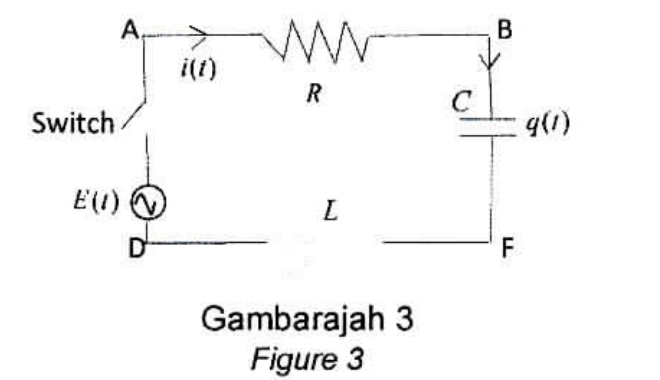
An inductor of L=4 henrys, a resistor of R=24 ohms and a capacitor of C=0.05 farads are connected in series with an emf of E volts as shown in Figure 3. Given the governing equation for RLC electrical circuit: Ldt2d2q(t)+Rdtdq(t)+C1q(t)=2te−t where q(t) is the charge of the circuit after t seconds. At t=0, the switch S is closed.
(i) Determine the general complementary solution, qc(t) of this equation.
Solution
Step 1 — Insert the numerical values.
With L=4, R=24 and C=0.05 (so C1=20):
4dt2d2q+24dtdq+20q=2te−t.
Dividing through by 4 puts the equation in standard form:
q′′+6q′+5q=21te−t.
Step 2 — Solve the homogeneous (complementary) equation.
For q′′+6q′+5q=0 try q=ert, giving the auxiliary (characteristic) equation
r2+6r+5=0⟹(r+1)(r+5)=0⟹r=−1,−5.
The roots are real and distinct, so the complementary solution is
qc(t)=c1e−t+c2e−5t,
where c1 and c2 are arbitrary constants.
(Physical reading: the circuit is overdamped, and both natural modes decay exponentially.)
(ii) Find the general particular solution, qp(t) of this equation.
Solution
Method — undetermined coefficients with resonance.
The right-hand side is 21te−t. The trial function for te−t would normally be e−t(At+B), but e−t is already a solution of the homogeneous equation (the root r=−1 of the auxiliary equation). This is the resonant case, so the trial function must be multiplied by t:
(iii) Let qc(t)=c1e−t+c2e−5t and qp(t)=e(−t)(161t2−321t), determine the total solution of charge q(t) of the given initial conditions, i(0)=0 and q(0)=0.
Solution
Method. Form the general solution q=qc+qp, differentiate to obtain the current i(t)=dtdq, and impose the two initial conditions to fix c1 and c2.
Solve the following differential equation using Power Series.
(1−x)dxdy−y=0
Solution
Method. Assume a power-series solution about the ordinary point x=0, y=∑n≥0anxn, substitute, and read off a recurrence relation for the coefficients.
Using Frobenius method, find the indicial roots for the following differential equation:
xy′′+y′+10y=0
Solution
Method.x=0 is a singular point. Substituting the Frobenius series y=∑n≥0anxn+r with a0=0 and equating the coefficient of the lowest power of x to zero gives the indicial equation.
Step 1 — Confirm x=0 is a regular singular point.
In standard form y′′+P(x)y′+Q(x)y=0,
P(x)=x1,Q(x)=x10,
so xP(x)=1 and x2Q(x)=10x are both analytic at x=0. Hence x=0 is a regular singular point and the Frobenius method applies.