Academic session 2017/2018, Semester 1 · 4 questions · 7 printed pages · 2 hours
(Jan 2018). Answer all questions. Questions are reproduced in English from the bilingual
original. Solutions are worked in full; numbers are given to a sensible precision.
Reference only — these are not official answers
These solutions are revision aids, not examiner answers. They were produced with the
help of a large language model and then checked, but an LLM can still be wrong:
expect the occasional arithmetic slip, a different method than your lecturer's, or a
misreading of the printed question. The question wording is reproduced by hand from a scan
of the original paper, so it too may differ in small ways from what was printed.
Use this page as a worked suggestion to check, not as ground truth. Always compare
against the original paper (linked above) and your own lecture notes, and if something here
disagrees with your lecturer, trust your lecturer. Marks shown are the paper's allocations,
not a marking scheme.
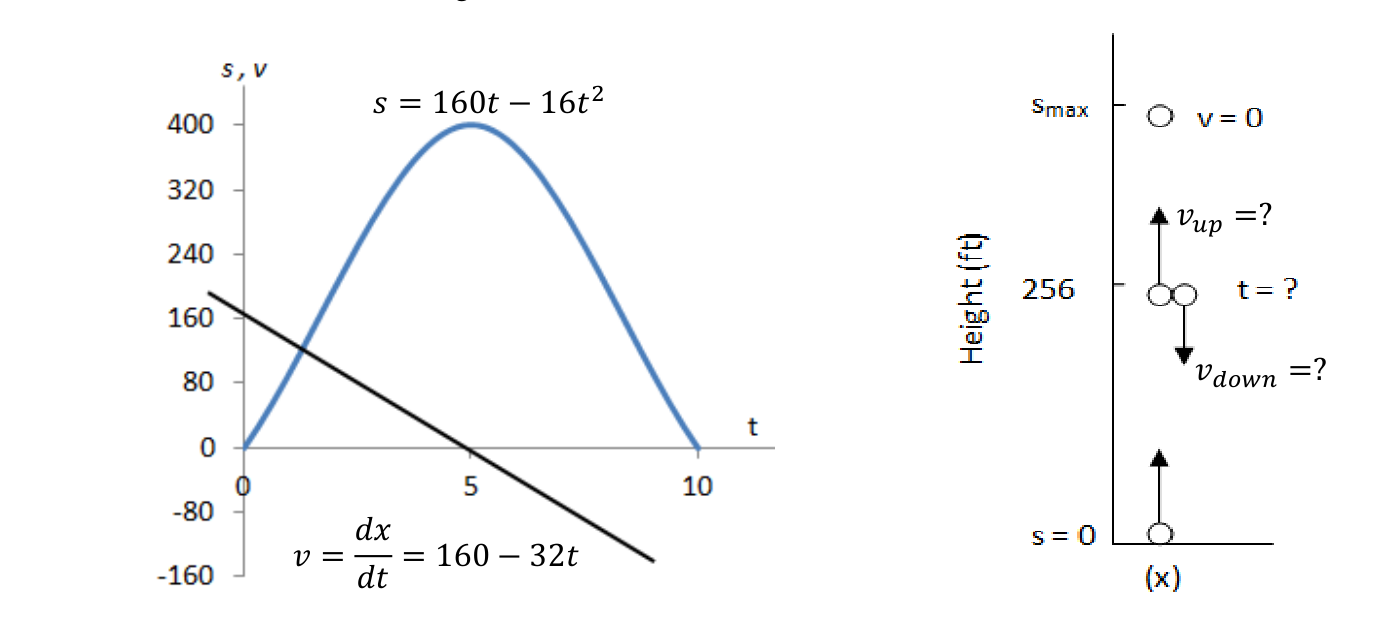
A dynamite blast blows a heavy rock straight up with a launch velocity of 160 ft/sec as
shown in Figure Q1. Its height is given by s=−16t2+160t. Note: The graphs of s and
v as functions of time; s is largest when v=dtds=0.
(i) How high does the rock go?
Solution
The height is greatest at the instant the velocity vanishes. Differentiate the height
function with respect to time:
v=dtds=dtd(−16t2+160t)=−32t+160
Set v=0 and solve for the time of maximum height:
−32t+160=0⟹t=5s
Substitute t=5 back into s:
smax=−16(5)2+160(5)=−400+800=400ft
This agrees with the peak of the parabola drawn in Figure Q1 (the vertex at
t=5 gives s=400 ft), and with v=0 at that instant as marked on the figure.
Answer: The rock rises to a maximum height of smax=400 ft (reached at t=5 s).
Acceleration is the derivative of velocity (the second derivative of displacement):
a=dtdv=dtd(−32t+160)=−32ft/s2
This is a constant — it does not depend on t — so it has the same value at every instant,
in particular at t=2 s and at t=8 s when the rock is 256 ft above the ground.
Physically, the value −32ft/s2 is the (constant) acceleration due to gravity
in imperial units, directed downwards.
Answer:a=−32ft/s2, i.e. a constant downward acceleration of
32ft/s2 — the same at 256 ft as at any other height.
The physically relevant root for the impact is t=10 s. Its velocity is
v(10)=−32(10)+160=−160ft/s
The negative sign confirms downward motion, and the speed of impact equals the launch speed
of 160 ft/s, as expected for motion under a constant acceleration with s(0)=s(10)=0.
note
The velocity label printed in Figure Q1 reads v=dtdx=160−32t. The
derivative must be taken with respect to the height variable s, i.e.
v=dtds=160−32t, which is the form used above and the form stated in the
question text.
Answer: The rock hits the ground at t=10 s with velocity v=−160 ft/s, i.e. a
speed of 160 ft/s directed downwards.
Check: 2−(−2)+2(4)=2+2+8=12, so the printed point does lie on the plane found —
as it must, since the plane was constructed through it. (The point does not, however, lie on
the printed sphere; see the note after the answer.)
Normal line. The normal line passes through (2,−2,4) with direction vector
(4,−4,8), equivalently (1,−1,2). In symmetric form:
1x−2=−1y+2=2z−4
or in parametric form:
(x,y,z)=(2+t,−2−t,4+2t),t∈R
Answer: Tangent plane: x−y+2z=12. Normal line:
1x−2=−1y+2=2z−4, i.e.
(x,y,z)=(2+t,−2−t,4+2t).
A misprint in the printed question
The point (2,−2,4) is not on the sphere x2+y2+z2=36: substituting gives
22+(−2)2+42=4+4+16=24=36. It lies on the concentric sphere
x2+y2+z2=24, of radius 24=26≈4.899.
Strictly, a sphere has no tangent plane at a point that is not on it, so the printed data are
mutually inconsistent. The solution above is the standard reading: it applies the
tangent-plane formula with ∇F(2,−2,4) exactly as the question instructs, which gives
the answer the paper expects, x−y+2z=12 (this is the tangent plane of the level
surface x2+y2+z2=24 through the printed point). Had the point been taken on the
printed sphere along the same radial direction, (6,−6,26),
the tangent plane would instead be x−y+2z=66≈14.70. The normal line is
unaffected by the misprint: it always has direction ∇F at the printed point.
Movement path of an autopilot ship is governed by the following equation:
dxdy+6y=5x, where the y and x variables are the distances travelled in
y-axis and x-axis respectively.
(i) Given the initial position of the ship is at (x,y) coordinate = (0,3), determine the
particular solution of the problem, y(x).
Solution
This is a first-order linear differential equation
dxdy+P(x)y=Q(x) with P(x)=6 and Q(x)=5x. Solve it with an
integrating factor.
I(x)=e∫P(x)dx=e∫6dx=e6x
Multiply the whole equation by e6x; the left side becomes an exact derivative:
e6xdxdy+6e6xy=5xe6x⟹dxd(ye6x)=5xe6x
Integrate both sides. Use integration by parts on the right with u=x,
dv=e6xdx, so du=dx and v=61e6x:
∫5xe6xdx=5[6xe6x−∫6e6xdx]=5[6xe6x−36e6x]+C
Hence
ye6x=(65x−365)e6x+Cy=65x−365+Ce−6x
Apply the initial condition y(0)=3:
3=0−365+C⟹C=3+365=36108+5=36113
Therefore the particular solution is
y(x)=65x−365+36113e−6x
Check:y(0)=−365+36113=36108=3. ✓ And
y′+6y=65−6113e−6x+5x−65+6113e−6x=5x. ✓
Answer:y(x)=65x−365+36113e−6x, i.e.
y(x)=365(6x−1)+36113e−6x.
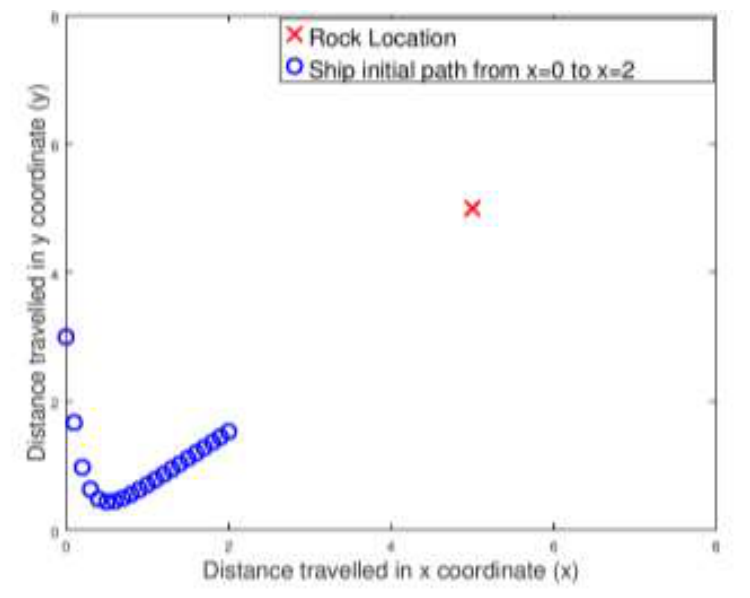
Predict if the ship will hit with the rock located at (x,y) coordinate = (5,5) when it
continue to travel from x=2 to x=5 as shown in the Figure Q3(a).
Solution
Evaluate the particular solution at the rock's x-coordinate, x=5:
The exponential term is negligible: e−30≈9.36×10⁻¹⁴, so
36113e−30≈2.9×10⁻¹³≈0. Thus
y(5)≈4.1667−0.1389=4.0278units
The rock sits at y=5, but the ship is at y≈4.03 when x=5 — it passes about
0.97 units below the rock. (For comparison, y(2)≈1.528 units, matching the
initial path plotted in Figure Q3(a).)
So the ship does not hit the rock.
Answer:y(5)≈4.03=5; the ship passes about 0.97 units below the rock, so it
does not collide with the rock at (5,5).
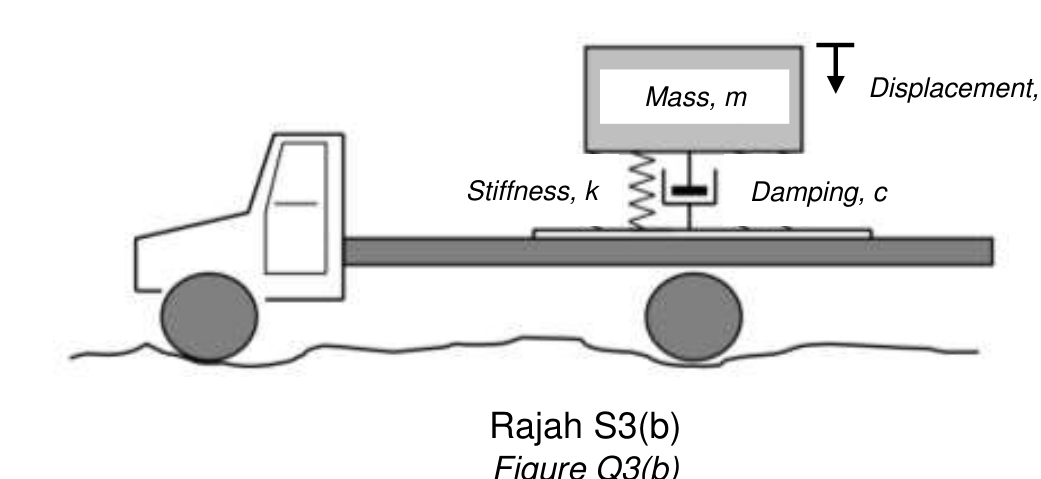
A truck is carrying goods with mass m=25 kg as shown in Figure Q3(b). A vibration
suppression system with stiffness k=40000 N/m and damping coefficient
c=2000 Ns/m has been installed to minimize the damage on the goods due to vibration.
Given the governing equation: mx¨+cx˙+kx=F(t) where F(t) is the forcing
function and x, x˙ & x¨ are the displacement, velocity and acceleration of
the mass respectively. Determine the general solution (i.e. total complementary and
particular solutions) of this equation: 25x¨+2000x˙+40000x=5sin(10t).
Hint: Euler's Formula: e±ix=cosx±i(sinx).
Solution
Step 1 — normalise the equation. Divide through by m=25:
x¨+80x˙+1600x=0.2sin(10t)
Step 2 — complementary solution xc. Solve the homogeneous equation
x¨+80x˙+1600x=0 with the trial solution x=ert; the auxiliary equation
is
r2+80r+1600=0⟹(r+40)2=0⟹r=−40(repeated)
A repeated real root gives
xc(t)=(A+Bt)e−40t
Step 3 — particular solution xp. Try xp=Csin10t+Dcos10t (the forcing has
frequency ω=10 rad/s, which is not a root of the auxiliary equation). Then
with A and B arbitrary constants fixed by the initial displacement and velocity.
Check and remarks. Substituting xp back into
25x¨+2000x˙+40000x returns exactly 5sin(10t). Since
ζ=2kmc=240000⋅252000=1, the system is
critically damped, which is why xc has the repeated-root form (A+Bt)e−40t and dies
away as t→∞, leaving only the steady-state oscillation xp. Written as a single
sinusoid, xp≈1.18×10⁻⁴sin(10t−0.490) m.
Writing c1=2a0−a1 and c2=a1−a0 gives the general solution
y=c1ex+c2e2x.
Check: the series solution is entire (the recurrence has no singularities for
m≥0, so the radius of convergence is infinite), and direct substitution of
y=erx into y′′−3y′+2y=0 gives r2−3r+2=(r−1)(r−2)=0, i.e. r=1
and r=2 — exactly the two independent solutions found above.
Answer:y=c1ex+c2e2x, where the power series gives the two independent
solutions y1=2ex−e2x (from a0=1, a1=0) and y2=e2x−ex
(from a0=0, a1=1).
Determine the singular point(s) of the given differential equation and classify it/them as
regular or irregular. Subsequently, find the indicial roots for the differential equation.
xy′′+2y′+4xy=0
Solution
Step 1 — write the equation in standard form. Divide by x:
y′′+x2y′+4y=0⟹P(x)=x2,Q(x)=4
Step 2 — locate the singular points.P(x)=x2 is undefined (not analytic) at
x=0, while Q(x)=4 is a polynomial and analytic everywhere. Hence x=0 is the only
singular point of the equation.
Step 3 — classify it. Test the two conditions for a regular singular point:
xP(x)=x⋅x2=2(analytic at x=0)x2Q(x)=x2⋅4=4x2(analytic at x=0)
Both are finite and analytic at x=0, so x=0 is a regular singular point (the
equation is of Frobenius type and a series solution of the form
y=xr∑n=0∞anxn exists).
The two roots differ by an integer (r1−r2=1). This is the borderline case in which a
logarithmic term may appear — but here it does not. The recurrence for the smaller root
r2=−1 never degenerates, so two independent Frobenius series exist and no logarithm is
needed. In fact, since (xy)′′=xy′′+2y′, the equation says exactly
dx2d2(xy)+4(xy)=0; writing u=xy gives u′′+4u=0, so
y1=xsin2x(r=0),y2=xcos2x(r=−1)
and the general solution is y=xc1sin2x+c2cos2x — with no logarithmic
term at all.
Answer: The only singular point is x=0, and it is a regular singular point
(xP(x)=2 and x2Q(x)=4x2 are both analytic at x=0). The indicial roots are
r1=0 and r2=−1 (from r2+r=0).