KIX1001 2018/2019 Semester 1

Paper details

Academic session 2018/2019, Semester 1 · 4 questions · 6 printed pages · 2 hours (Jan 2019). Answer all questions. Questions are reproduced in English from the bilingual original. Solutions are worked in full; numerical results are quoted to a sensible precision.

Reference only — these are not official answers

These solutions are revision aids, not examiner answers. They were produced with the help of a large language model and then checked, but an LLM can still be wrong: expect the occasional arithmetic slip, a different method than your lecturer's, or a misreading of the printed question. The question wording is reproduced by hand from a scan of the original paper, so it too may differ in small ways from what was printed.

Use this page as a worked suggestion to check, not as ground truth. Always compare against the original paper (linked above) and your own lecture notes, and if something here disagrees with your lecturer, trust your lecturer. Marks shown are the paper's allocations, not a marking scheme.

Question 1​

Question 1(a) (4 marks)​

Question

Find all of the first and second order partial derivative for the function f(x,y)=(yx)ln⁡xf(x,y) = \left(\dfrac{y}{x}\right)\ln x.

Solution

Write the function with a negative power so that each differentiation is a product: f(x,y)=y x−1ln⁡xf(x,y) = y\,x^{-1}\ln x.

First order partial derivatives. Treat the other variable as a constant.

Differentiate with respect to xx using the product rule on x−1ln⁡xx^{-1}\ln x:

∂f∂x=y ddx(x−1ln⁡x)=y(−x−2ln⁡x+x−1⋅1x)=y(1−ln⁡xx2)\begin{aligned} \frac{\partial f}{\partial x} &= y\,\frac{d}{dx}\left(x^{-1}\ln x\right)\\ &= y\left(-x^{-2}\ln x + x^{-1}\cdot\frac{1}{x}\right) = y\left(\frac{1-\ln x}{x^{2}}\right) \end{aligned}

Differentiate with respect to yy (the factor ln⁡x/x\ln x / x is a constant for this step):

∂f∂y=ln⁡xx\frac{\partial f}{\partial y} = \frac{\ln x}{x}

Second order partial derivatives. Differentiate each first derivative once more.

∂2f∂x2=∂∂x[y(1−ln⁡x)x−2]=y[−1x⋅x−2+(1−ln⁡x)(−2x−3)]=y(2ln⁡x−3)x3\begin{aligned} \frac{\partial^{2} f}{\partial x^{2}} &= \frac{\partial}{\partial x}\left[y(1-\ln x)x^{-2}\right]\\ &= y\left[-\frac{1}{x}\cdot x^{-2} + (1-\ln x)(-2x^{-3})\right] = \frac{y(2\ln x - 3)}{x^{3}} \end{aligned}∂2f∂y2=∂∂y(ln⁡xx)=0\frac{\partial^{2} f}{\partial y^{2}} = \frac{\partial}{\partial y}\left(\frac{\ln x}{x}\right) = 0

The second derivative with respect to yy vanishes because ff is linear in yy.

∂2f∂x ∂y=∂∂y(y(1−ln⁡x)x2)=1−ln⁡xx2∂2f∂y ∂x=∂∂x(ln⁡xx)=1⋅x−ln⁡x⋅1x2=1−ln⁡xx2\begin{aligned} \frac{\partial^{2} f}{\partial x\,\partial y} &= \frac{\partial}{\partial y}\left(\frac{y(1-\ln x)}{x^{2}}\right) = \frac{1-\ln x}{x^{2}}\\ \frac{\partial^{2} f}{\partial y\,\partial x} &= \frac{\partial}{\partial x}\left(\frac{\ln x}{x}\right) = \frac{1\cdot x - \ln x\cdot 1}{x^{2}} = \frac{1-\ln x}{x^{2}} \end{aligned}

The two mixed derivatives agree, as required by Clairaut's theorem, since ff and its derivatives are continuous for x>0x > 0.

Answer: fx=y(1−ln⁡x)x2f_x = \dfrac{y(1-\ln x)}{x^{2}}, fy=ln⁡xxf_y = \dfrac{\ln x}{x}, fxx=y(2ln⁡x−3)x3f_{xx} = \dfrac{y(2\ln x-3)}{x^{3}}, fyy=0f_{yy} = 0, fxy=fyx=1−ln⁡xx2f_{xy} = f_{yx} = \dfrac{1-\ln x}{x^{2}}.


Question 1(b) (6 marks)​

Question

The radius of a circular cylinder is measured to be r=10±0.01r = 10 \pm 0.01 cm and its height is measured to be h=15±0.005h = 15 \pm 0.005 cm. Use differentials to estimate the maximum possible error in the volume of the cylinder that is calculated using r=10r = 10 and h=15h = 15.

Solution

Technique: total differential of a function of two variables.

The volume of a circular cylinder is V=πr2hV = \pi r^{2}h. The measurement errors are small, so the change in VV is approximated by the total differential

dV=∂V∂r dr+∂V∂h dh=2πrh dr+πr2 dhdV = \frac{\partial V}{\partial r}\,dr + \frac{\partial V}{\partial h}\,dh = 2\pi r h\,dr + \pi r^{2}\,dh

At the nominal point r=10r = 10 cm, h=15h = 15 cm:

∂V∂r=2π(10)(15)=300π cm2,∂V∂h=π(10)2=100π cm2\frac{\partial V}{\partial r} = 2\pi(10)(15) = 300\pi\ \text{cm}^{2}, \qquad \frac{\partial V}{\partial h} = \pi(10)^{2} = 100\pi\ \text{cm}^{2}

The maximum possible error is obtained by taking the absolute values of the measurement errors, ∣dr∣=0.01|dr| = 0.01 cm and ∣dh∣=0.005|dh| = 0.005 cm (worst case: both errors act in the same sense):

∣ΔV∣≈∣2πrh∣ ∣dr∣+∣πr2∣ ∣dh∣=300π(0.01)+100π(0.005)|\Delta V| \approx \left|2\pi r h\right|\,|dr| + \left|\pi r^{2}\right|\,|dh| = 300\pi(0.01) + 100\pi(0.005)∣ΔV∣≈3π+0.5π=3.5π≈10.996 cm3|\Delta V| \approx 3\pi + 0.5\pi = 3.5\pi \approx 10.996\ \text{cm}^{3}

For context, the nominal volume is V=π(10)2(15)=1500π≈4712.39 cm3V = \pi(10)^{2}(15) = 1500\pi \approx 4712.39\ \text{cm}^{3}, so the relative (percentage) error is at most

∣ΔV∣V=3.5π1500π=73000≈0.233%\frac{|\Delta V|}{V} = \frac{3.5\pi}{1500\pi} = \frac{7}{3000} \approx 0.233\%

which confirms that treating the error as a differential is legitimate here.

Answer: ∣ΔV∣≈3.5π≈11.0 cm3|\Delta V| \approx 3.5\pi \approx 11.0\ \text{cm}^{3} (a relative error of about 0.23%0.23\%), so the computed volume is 1500π≈4712 cm31500\pi \approx 4712\ \text{cm}^{3} to within ±11 cm3\pm 11\ \text{cm}^{3}.


Question 1(c) (5 marks)​

Question

Consider the surface x2+y2+2x−4y−z=−7x^{2} + y^{2} + 2x - 4y - z = -7. Identify the type of surface and find the equation of the normal line in parametric form and tangent plane to this surface at the point (−2,2)(-2, 2).

Solution

Step 1 — the missing coordinate of the point. The point is given as (−2,2)(-2,2); substitute x=−2x = -2, y=2y = 2 into the surface equation to find zz:

(−2)2+(2)2+2(−2)−4(2)−z=−7  ⟹  4+4−4−8−z=−7  ⟹  −4−z=−7  ⟹  z=3(-2)^{2} + (2)^{2} + 2(-2) - 4(2) - z = -7 \;\Longrightarrow\; 4 + 4 - 4 - 8 - z = -7 \;\Longrightarrow\; -4 - z = -7 \;\Longrightarrow\; z = 3

So the point of contact is P(−2, 2, 3)P(-2,\,2,\,3).

Step 2 — identify the surface. Complete the square in xx and in yy:

x2+2x=(x+1)2−1,y2−4y=(y−2)2−4x^{2} + 2x = (x+1)^{2} - 1, \qquad y^{2} - 4y = (y-2)^{2} - 4(x+1)2−1+(y−2)2−4−z=−7  ⟹  (x+1)2+(y−2)2=z−2(x+1)^{2} - 1 + (y-2)^{2} - 4 - z = -7 \;\Longrightarrow\; (x+1)^{2} + (y-2)^{2} = z - 2z=(x+1)2+(y−2)2+2z = (x+1)^{2} + (y-2)^{2} + 2

This is a circular paraboloid (a special elliptic paraboloid, since the two quadratic coefficients are equal). Its vertex is (−1, 2, 2)(-1,\,2,\,2), its axis is the vertical line x=−1, y=2x = -1,\ y = 2, and it opens upwards in the +z+z direction.

Step 3 — gradient (normal vector). Write the surface as a level surface F(x,y,z)=0F(x,y,z) = 0 with F(x,y,z)=x2+y2+2x−4y−z+7F(x,y,z) = x^{2} + y^{2} + 2x - 4y - z + 7. Then

∇F=(2x+2,  2y−4,  −1)\nabla F = \left(2x + 2,\; 2y - 4,\; -1\right)

At P(−2,2,3)P(-2,2,3):

∇F∣P=(2(−2)+2,  2(2)−4,  −1)=(−2,  0,  −1)\nabla F\big|_{P} = \left(2(-2)+2,\; 2(2)-4,\; -1\right) = (-2,\;0,\;-1)

This vector is normal to the surface (and hence to the tangent plane) at PP.

Step 4 — normal line (parametric form). A line through PP with direction (−2,0,−1)(-2,0,-1) is r(t)=(−2, 2, 3)+t (−2, 0, −1)\mathbf{r}(t) = (-2,\,2,\,3) + t\,(-2,\,0,\,-1), that is

x=−2−2t,y=2,z=3−t,t∈Rx = -2 - 2t, \qquad y = 2, \qquad z = 3 - t, \qquad t \in \mathbb{R}

Since yy never changes, the normal line lies in the plane y=2y = 2.

Step 5 — tangent plane. For a level surface, the tangent plane at PP is ∇F∣P⋅(x+2,  y−2,  z−3)=0\nabla F|_{P}\cdot\left(x + 2,\; y - 2,\; z - 3\right) = 0:

−2(x+2)+0(y−2)−1(z−3)=0-2(x+2) + 0(y-2) - 1(z-3) = 0−2x−4−z+3=0  ⟹  −2x−z−1=0  ⟹  2x+z+1=0-2x - 4 - z + 3 = 0 \;\Longrightarrow\; -2x - z - 1 = 0 \;\Longrightarrow\; 2x + z + 1 = 0

Check: the plane passes through PP: 2(−2)+3+1=02(-2) + 3 + 1 = 0. ✓

Answer: The surface is a circular paraboloid z=(x+1)2+(y−2)2+2z = (x+1)^{2} + (y-2)^{2} + 2 (vertex (−1,2,2)(-1,2,2), opening upwards). The normal line is x=−2−2t, y=2, z=3−tx = -2 - 2t,\ y = 2,\ z = 3 - t, and the tangent plane at (−2,2,3)(-2,2,3) is 2x+z+1=02x + z + 1 = 0.


Question 2​

Question 2(a) (4 marks)​

Question

Ace Novelty wishes to produce three types of souvenirs: types AA, BB and CC. To manufacture a type-AA souvenir requires 2 minutes on machine I, 1 minute on machine II, and 2 minutes on machine III. A type-BB souvenir requires 1 minute on machine I, 3 minutes on machine II and 1 minute on machine III. A type-CC souvenir requires 1 minute on machine I, 2 minutes on machines II and 2 minutes on III. There are 3 hours available on machine I, 5 hours available on machine II, and 4 hours available on machine III for processing the order. How many souvenirs of each type should Ace Novelty make in order to use all of the available time?

Solution

Technique: model the order as a 3×33\times 3 linear system and solve it by Gaussian elimination.

Let aa, bb and cc be the numbers of type-AA, type-BB and type-CC souvenirs produced. Convert the available times to minutes: machine I has 3×60=1803 \times 60 = 180 min, machine II has 5×60=3005 \times 60 = 300 min and machine III has 4×60=2404 \times 60 = 240 min. "Use all of the available time" means every machine runs for exactly its full available time:

2a+b+c=180(machine I)a+3b+2c=300(machine II)2a+b+2c=240(machine III)\begin{aligned} 2a + b + c &= 180 \qquad \text{(machine I)}\\ a + 3b + 2c &= 300 \qquad \text{(machine II)}\\ 2a + b + 2c &= 240 \qquad \text{(machine III)} \end{aligned}

Elimination. Subtract the first equation from the third:

(2a+b+2c)−(2a+b+c)=240−180  ⟹  c=60(2a + b + 2c) - (2a + b + c) = 240 - 180 \;\Longrightarrow\; c = 60

Substitute c=60c = 60 back into the first and second equations:

2a+b=120(1)2a + b = 120 \qquad (1)a+3b+120=300  ⟹  a+3b=180(2)a + 3b + 120 = 300 \;\Longrightarrow\; a + 3b = 180 \qquad (2)

From (1), b=120−2ab = 120 - 2a. Substitute into (2):

a+3(120−2a)=180  ⟹  a+360−6a=180  ⟹  −5a=−180  ⟹  a=36a + 3(120 - 2a) = 180 \;\Longrightarrow\; a + 360 - 6a = 180 \;\Longrightarrow\; -5a = -180 \;\Longrightarrow\; a = 36

Then b=120−2(36)=48b = 120 - 2(36) = 48.

Check (total machine minutes used):

MachineRequiredComputedAvailable
I2a+b+c2a+b+c72+48+60=18072+48+60 = 180180 min
IIa+3b+2ca+3b+2c36+144+120=30036+144+120 = 300300 min
III2a+b+2c2a+b+2c72+48+120=24072+48+120 = 240240 min

All three machines are fully used, so the solution is consistent. Since the coefficient matrix has determinant 5≠05 \neq 0, the solution is also unique.

Answer: Ace Novelty should make 3636 type-AA, 4848 type-BB and 6060 type-CC souvenirs.


Question 2(b) (7 marks)​

Question

Find the eigen values and eigen vectors of matrix:

A=(522363669)A = \begin{pmatrix} 5 & 2 & 2 \\ 3 & 6 & 3 \\ 6 & 6 & 9 \end{pmatrix}
Solution

Technique: solve the characteristic equation det⁡(A−λI)=0\det(A - \lambda I) = 0, then for each eigenvalue solve (A−λI)v=0(A - \lambda I)\mathbf{v} = \mathbf{0}.

Step 1 — characteristic equation.

A−λI=(5−λ2236−λ3669−λ)A - \lambda I = \begin{pmatrix} 5-\lambda & 2 & 2 \\ 3 & 6-\lambda & 3 \\ 6 & 6 & 9-\lambda \end{pmatrix}

Expand along the first row:

det⁡(A−λI)=(5−λ)[(6−λ)(9−λ)−18]−2[3(9−λ)−18]+2[18−6(6−λ)]\det(A-\lambda I) = (5-\lambda)\big[(6-\lambda)(9-\lambda) - 18\big] - 2\big[3(9-\lambda) - 18\big] + 2\big[18 - 6(6-\lambda)\big]

Evaluate each bracket:

(6−λ)(9−λ)−18=λ2−15λ+54−18=λ2−15λ+36(6-\lambda)(9-\lambda) - 18 = \lambda^{2} - 15\lambda + 54 - 18 = \lambda^{2} - 15\lambda + 363(9−λ)−18=27−3λ−18=9−3λ3(9-\lambda) - 18 = 27 - 3\lambda - 18 = 9 - 3\lambda18−6(6−λ)=18−36+6λ=6λ−1818 - 6(6-\lambda) = 18 - 36 + 6\lambda = 6\lambda - 18

Hence

det⁡(A−λI)=(5−λ)(λ2−15λ+36)−2(9−3λ)+2(6λ−18)=(5−λ)(λ2−15λ+36)−18+6λ+12λ−36=(5−λ)(λ2−15λ+36)+18λ−54\begin{aligned} \det(A-\lambda I) &= (5-\lambda)(\lambda^{2}-15\lambda+36) - 2(9-3\lambda) + 2(6\lambda-18)\\ &= (5-\lambda)(\lambda^{2}-15\lambda+36) - 18 + 6\lambda + 12\lambda - 36\\ &= (5-\lambda)(\lambda^{2}-15\lambda+36) + 18\lambda - 54 \end{aligned}

Expand the product:

(5−λ)(λ2−15λ+36)=5λ2−75λ+180−λ3+15λ2−36λ=−λ3+20λ2−111λ+180\begin{aligned} (5-\lambda)(\lambda^{2}-15\lambda+36) &= 5\lambda^{2} - 75\lambda + 180 - \lambda^{3} + 15\lambda^{2} - 36\lambda\\ &= -\lambda^{3} + 20\lambda^{2} - 111\lambda + 180 \end{aligned}

Therefore det⁡(A−λI)=−λ3+20λ2−93λ+126=0\det(A-\lambda I) = -\lambda^{3} + 20\lambda^{2} - 93\lambda + 126 = 0, or, multiplying by −1-1, the characteristic equation

λ3−20λ2+93λ−126=0\lambda^{3} - 20\lambda^{2} + 93\lambda - 126 = 0

Step 2 — roots. Try λ=3\lambda = 3: 27−180+279−126=027 - 180 + 279 - 126 = 0. ✓ So (λ−3)(\lambda - 3) is a factor, and division gives

λ3−20λ2+93λ−126=(λ−3)(λ2−17λ+42)\lambda^{3} - 20\lambda^{2} + 93\lambda - 126 = (\lambda - 3)(\lambda^{2} - 17\lambda + 42)

and λ2−17λ+42=(λ−3)(λ−14)\lambda^{2} - 17\lambda + 42 = (\lambda - 3)(\lambda - 14). So

(λ−3)2(λ−14)=0  ⟹  λ=3 (algebraic multiplicity 2),λ=14(\lambda - 3)^{2}(\lambda - 14) = 0 \;\Longrightarrow\; \lambda = 3 \text{ (algebraic multiplicity 2)}, \qquad \lambda = 14

Step 3 — eigenvectors for λ=3\lambda = 3. Solve (A−3I)v=0(A - 3I)\mathbf{v} = \mathbf{0}:

(222333666)(xyz)=(000)\begin{pmatrix} 2 & 2 & 2 \\ 3 & 3 & 3 \\ 6 & 6 & 6 \end{pmatrix} \begin{pmatrix} x \\ y \\ z \end{pmatrix} = \begin{pmatrix} 0 \\ 0 \\ 0 \end{pmatrix}

All three rows reduce to the single condition x+y+z=0x + y + z = 0. Two independent solutions may be read off (e.g. set z=0z = 0, then set y=0y = 0):

v1=(−110),v2=(−101)\mathbf{v}_1 = \begin{pmatrix} -1 \\ 1 \\ 0 \end{pmatrix}, \qquad \mathbf{v}_2 = \begin{pmatrix} -1 \\ 0 \\ 1 \end{pmatrix}

Any non-zero combination α(−1,1,0)+β(−1,0,1)\alpha(-1,1,0) + \beta(-1,0,1) is also an eigenvector for λ=3\lambda = 3. This eigenspace is two-dimensional, which is the largest possible for a double eigenvalue, so the geometric multiplicity (2) equals the algebraic multiplicity (2). Together with the eigenvector for λ=14\lambda = 14, the matrix therefore has three linearly independent eigenvectors and is diagonalizable, even though it is not symmetric.

Step 4 — eigenvector for λ=14\lambda = 14. Solve (A−14I)v=0(A - 14I)\mathbf{v} = \mathbf{0}:

(−9223−8366−5)(xyz)=(000)\begin{pmatrix} -9 & 2 & 2 \\ 3 & -8 & 3 \\ 6 & 6 & -5 \end{pmatrix} \begin{pmatrix} x \\ y \\ z \end{pmatrix} = \begin{pmatrix} 0 \\ 0 \\ 0 \end{pmatrix}

From row 1: −9x+2y+2z=0-9x + 2y + 2z = 0. From row 2: 3x−8y+3z=03x - 8y + 3z = 0. Eliminating xx (row 2 multiplied by 3, plus row 1):

(9x−24y+9z)+(−9x+2y+2z)=0  ⟹  −22y+11z=0  ⟹  z=2y(9x - 24y + 9z) + (-9x + 2y + 2z) = 0 \;\Longrightarrow\; -22y + 11z = 0 \;\Longrightarrow\; z = 2y

Substitute z=2yz = 2y into −9x+2y+2z=0-9x + 2y + 2z = 0:

−9x+2y+4y=0  ⟹  −9x+6y=0  ⟹  x=23y-9x + 2y + 4y = 0 \;\Longrightarrow\; -9x + 6y = 0 \;\Longrightarrow\; x = \tfrac{2}{3}y

Choosing y=3y = 3 gives x=2x = 2 and z=6z = 6:

v3=(236)\mathbf{v}_3 = \begin{pmatrix} 2 \\ 3 \\ 6 \end{pmatrix}

Check: Av3=(10+6+12,  6+18+18,  12+18+54)=(28, 42, 84)=14 (2,3,6)A\mathbf{v}_3 = (10+6+12,\;6+18+18,\;12+18+54) = (28,\,42,\,84) = 14\,(2,3,6). ✓

Answer: λ1=3\lambda_1 = 3 (double) with eigenvectors v1=(−1, 1, 0)T\mathbf{v}_1 = (-1,\,1,\,0)^{\mathsf{T}} and v2=(−1, 0, 1)T\mathbf{v}_2 = (-1,\,0,\,1)^{\mathsf{T}}; and λ2=14\lambda_2 = 14 with eigenvector v3=(2, 3, 6)T\mathbf{v}_3 = (2,\,3,\,6)^{\mathsf{T}}.


Question 2(c) (4 marks)​

Question

Based on characteristic equation from (b), calculate inverse matrix AA using Cayley Hamilton approach.

Solution

Technique: the Cayley-Hamilton theorem, which states that a matrix satisfies its own characteristic equation.

From part (b) the characteristic equation is λ3−20λ2+93λ−126=0\lambda^{3} - 20\lambda^{2} + 93\lambda - 126 = 0. By Cayley-Hamilton, replacing λ\lambda by AA (and the constant term by 126I126I) gives

A3−20A2+93A−126I=0A^{3} - 20A^{2} + 93A - 126I = 0

Step 1 — obtain A−1A^{-1}. Since det⁡(A)=126≠0\det(A) = 126 \neq 0, AA is invertible. Multiply the matrix equation by A−1A^{-1}:

A2−20A+93I−126A−1=0A^{2} - 20A + 93I - 126A^{-1} = 0A−1=1126(A2−20A+93I)A^{-1} = \frac{1}{126}\left(A^{2} - 20A + 93I\right)

Step 2 — compute A2A^{2}.

A2=(522363669)(522363669)=(433434516051102102111)A^{2} = \begin{pmatrix} 5 & 2 & 2 \\ 3 & 6 & 3 \\ 6 & 6 & 9 \end{pmatrix} \begin{pmatrix} 5 & 2 & 2 \\ 3 & 6 & 3 \\ 6 & 6 & 9 \end{pmatrix} = \begin{pmatrix} 43 & 34 & 34 \\ 51 & 60 & 51 \\ 102 & 102 & 111 \end{pmatrix}

For example, row 1 is (25+6+12,  10+12+12,  10+6+18)=(43, 34, 34)(25+6+12,\;10+12+12,\;10+6+18) = (43,\,34,\,34).

Step 3 — form A2−20A+93IA^{2} - 20A + 93I.

−20A=(−100−40−40−60−120−60−120−120−180),93I=(930009300093)-20A = \begin{pmatrix} -100 & -40 & -40 \\ -60 & -120 & -60 \\ -120 & -120 & -180 \end{pmatrix}, \qquad 93I = \begin{pmatrix} 93 & 0 & 0 \\ 0 & 93 & 0 \\ 0 & 0 & 93 \end{pmatrix}A2−20A+93I=(43−100+9334−40+034−40+051−60+060−120+9351−60+0102−120+0102−120+0111−180+93)=(36−6−6−933−9−18−1824)A^{2} - 20A + 93I = \begin{pmatrix} 43-100+93 & 34-40+0 & 34-40+0 \\ 51-60+0 & 60-120+93 & 51-60+0 \\ 102-120+0 & 102-120+0 & 111-180+93 \end{pmatrix} = \begin{pmatrix} 36 & -6 & -6 \\ -9 & 33 & -9 \\ -18 & -18 & 24 \end{pmatrix}

Step 4 — divide by 126126.

A−1=1126(36−6−6−933−9−18−1824)=(27−121−121−1141142−114−17−17421)A^{-1} = \frac{1}{126}\begin{pmatrix} 36 & -6 & -6 \\ -9 & 33 & -9 \\ -18 & -18 & 24 \end{pmatrix} = \begin{pmatrix} \tfrac{2}{7} & -\tfrac{1}{21} & -\tfrac{1}{21} \\ -\tfrac{1}{14} & \tfrac{11}{42} & -\tfrac{1}{14} \\ -\tfrac{1}{7} & -\tfrac{1}{7} & \tfrac{4}{21} \end{pmatrix}

Check: the top-left entry of AA−1A A^{-1} is 5⋅27+2⋅(−114)+2⋅(−17)=107−17−27=15\cdot\tfrac{2}{7} + 2\cdot\left(-\tfrac{1}{14}\right) + 2\cdot\left(-\tfrac{1}{7}\right) = \tfrac{10}{7} - \tfrac{1}{7} - \tfrac{2}{7} = 1. ✓

Answer: A−1=1126(36−6−6−933−9−18−1824)=(27−121−121−1141142−114−17−17421)A^{-1} = \dfrac{1}{126}\begin{pmatrix} 36 & -6 & -6 \\ -9 & 33 & -9 \\ -18 & -18 & 24 \end{pmatrix} = \begin{pmatrix} \tfrac{2}{7} & -\tfrac{1}{21} & -\tfrac{1}{21} \\ -\tfrac{1}{14} & \tfrac{11}{42} & -\tfrac{1}{14} \\ -\tfrac{1}{7} & -\tfrac{1}{7} & \tfrac{4}{21} \end{pmatrix}.


Question 3​

Question 3(a)(i) (5 marks)​

Question

The velocity, vv of a parachutist of mass, m=90m = 90 kg is governed by the following equation:

mdvdt=mg−cv,m\frac{dv}{dt} = mg - cv,

where the gg and cc variables are the gravity coefficient (i.e. 9.819.81 m/s) and drag coefficient (i.e. 1515 kg/s) respectively.

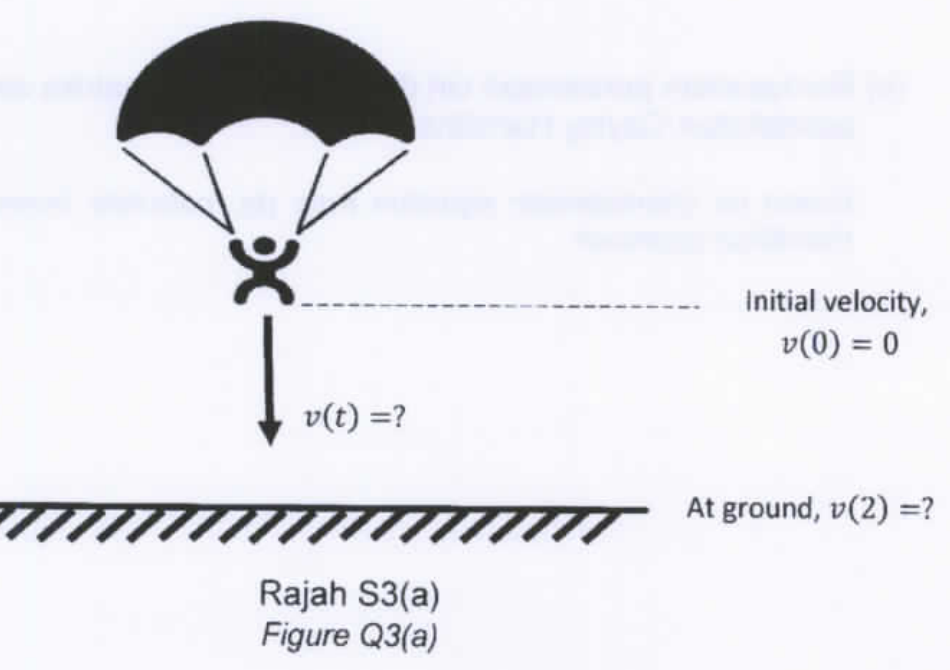
(i) Given the initial velocity of the parachutist is zero, v(0)=0v(0) = 0, calculate the velocity function of the parachutist over time, v(t)v(t) as shown in Figure Q3(a).

Units in the printed paper

The paper writes the gravitational acceleration as "9.819.81 m/s", which is a velocity unit; the correct unit is m/s2^{2}. The value g=9.81g = 9.81 m/s2^{2} is used throughout the solution below.

Figure Q3(a): a parachutist falling with initial velocity v(0) = 0, reaching the ground after 2 seconds
Solution

Technique: first-order linear ODE — separate the variables and apply the initial condition.

With m=90m = 90 kg, g=9.81g = 9.81 m/s2^{2} and c=15c = 15 kg/s, the governing equation becomes

90dvdt=90(9.81)−15v⟹dvdt=9.81−1590v=9.81−v690\frac{dv}{dt} = 90(9.81) - 15v \qquad\Longrightarrow\qquad \frac{dv}{dt} = 9.81 - \frac{15}{90}v = 9.81 - \frac{v}{6}

Step 1 — separate the variables.

dv9.81−v6=dt\frac{dv}{9.81 - \dfrac{v}{6}} = dt

Step 2 — integrate. Since ddvln⁡ ⁣(9.81−v6)=−1/69.81−v/6\dfrac{d}{dv}\ln\!\left(9.81 - \dfrac{v}{6}\right) = \dfrac{-1/6}{9.81 - v/6}, we get

∫dv9.81−v6=−6ln⁡ ⁣∣9.81−v6∣\int \frac{dv}{9.81 - \dfrac{v}{6}} = -6\ln\!\left|9.81 - \frac{v}{6}\right|

so

−6ln⁡ ⁣∣9.81−v6∣=t+K⟹ln⁡ ⁣∣9.81−v6∣=−t6+K′-6\ln\!\left|9.81 - \frac{v}{6}\right| = t + K \qquad\Longrightarrow\qquad \ln\!\left|9.81 - \frac{v}{6}\right| = -\frac{t}{6} + K'

Exponentiating both sides,

9.81−v6=C e−t/6⟹v(t)=6(9.81−C e−t/6)=58.86(1−C9.81e−t/6)9.81 - \frac{v}{6} = C\,e^{-t/6} \qquad\Longrightarrow\qquad v(t) = 6\left(9.81 - C\,e^{-t/6}\right) = 58.86\left(1 - \frac{C}{9.81}e^{-t/6}\right)

Step 3 — apply v(0)=0v(0) = 0.

0=58.86(1−C9.81)  ⟹  C=9.810 = 58.86\left(1 - \frac{C}{9.81}\right) \;\Longrightarrow\; C = 9.81

Hence

v(t)=58.86(1−e−t/6) m/sv(t) = 58.86\left(1 - e^{-t/6}\right)\ \text{m/s}

Check: v(0)=58.86(1−1)=0v(0) = 58.86(1-1) = 0 ✓. As t→∞t \to \infty, v→mgc=90(9.81)15=58.86v \to \dfrac{mg}{c} = \dfrac{90(9.81)}{15} = 58.86 m/s, the terminal velocity, so dv/dt→0dv/dt \to 0 and the ODE is satisfied. ✓

Answer: v(t)=58.86(1−e−t/6)v(t) = 58.86\left(1 - e^{-t/6}\right) m/s, i.e. v(t)=mgc(1−e−ct/m)v(t) = \dfrac{mg}{c}\left(1 - e^{-ct/m}\right) with terminal velocity 58.8658.86 m/s.


Question 3(a)(ii) (2 marks)​

Question

Based on the standard, the safe landing velocity should not exceed 4.84.8 m/s. If it takes 22 seconds for the parachutist to reach the ground, calculate the landing velocity and evaluate whether it is a safe landing.

Solution

Substitute t=2t = 2 s into the velocity function from part (i):

v(2)=58.86(1−e−2/6)=58.86(1−e−1/3)v(2) = 58.86\left(1 - e^{-2/6}\right) = 58.86\left(1 - e^{-1/3}\right)

With e−1/3≈0.716531e^{-1/3} \approx 0.716531:

v(2)≈58.86 (1−0.716531)=58.86 (0.283469)≈16.68 m/sv(2) \approx 58.86\,(1 - 0.716531) = 58.86\,(0.283469) \approx 16.68\ \text{m/s}

Comparing with the safe limit, 16.68 m/s>4.8 m/s16.68\ \text{m/s} > 4.8\ \text{m/s}, so the landing is not safe — the impact speed is roughly 3.53.5 times the permitted maximum. Even at t=2t = 2 s the parachutist is far from terminal velocity, so the drag has not yet slowed the fall enough.

Answer: v(2)≈16.7v(2) \approx 16.7 m/s, which exceeds the safe limit of 4.84.8 m/s; the landing is not safe.


Question 3(b)(i) (6 marks)​

Question

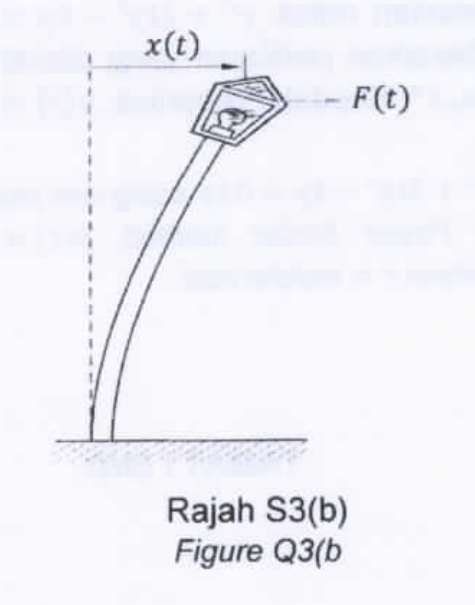
A lamp post is vibrating under wind excitation, F(t)F(t) as shown in Figure Q3(b). The vibration at the tip of the lamp post can be governed by the following equation:

mx¨+cx˙+kx=F(t)m\ddot{x} + c\dot{x} + kx = F(t)

where F(t)F(t) is the forcing function, mm is the mass, cc is the damping coefficient, kk is the stiffness and xx, x˙\dot{x} & x¨\ddot{x} are the displacement, velocity and acceleration of the mass respectively.

(i) Determine the general solution (i.e. total complementary and particular solutions) of this equation: 30x¨+120x˙+390x=120cos⁡(3t)30\ddot{x} + 120\dot{x} + 390x = 120\cos(3t). Hint: Euler's Formula: e±ix=cos⁡x±i(sin⁡x)e^{\pm ix} = \cos x \pm i(\sin x).

Figure Q3(b): a lamp post bending under wind excitation F(t), with tip displacement x(t)
Solution

Technique: solve the constant-coefficient linear ODE as x=xc+xpx = x_c + x_p — complementary function from the auxiliary equation, particular integral by the method of undetermined coefficients.

Divide through by 3030 to normalise the leading coefficient:

x¨+4x˙+13x=4cos⁡(3t)\ddot{x} + 4\dot{x} + 13x = 4\cos(3t)

Step 1 — complementary function xcx_c. Solve the homogeneous equation x¨+4x˙+13x=0\ddot{x} + 4\dot{x} + 13x = 0 with the trial x=eλtx = e^{\lambda t}:

λ2+4λ+13=0  ⟹  λ=−4±16−522=−4±−362=−2±3i\lambda^{2} + 4\lambda + 13 = 0 \;\Longrightarrow\; \lambda = \frac{-4 \pm \sqrt{16 - 52}}{2} = \frac{-4 \pm \sqrt{-36}}{2} = -2 \pm 3i

Using Euler's formula e(−2±3i)t=e−2t(cos⁡3t±isin⁡3t)e^{(-2\pm 3i)t} = e^{-2t}\left(\cos 3t \pm i\sin 3t\right), the complementary function is

xc(t)=e−2t(Acos⁡3t+Bsin⁡3t)x_c(t) = e^{-2t}\left(A\cos 3t + B\sin 3t\right)

Step 2 — particular integral xpx_p. Because the forcing is cos⁡3t\cos 3t and ±3i\pm 3i is not a root of the auxiliary equation (the roots are −2±3i-2 \pm 3i), try

xp=Ccos⁡3t+Dsin⁡3tx_p = C\cos 3t + D\sin 3txp′=−3Csin⁡3t+3Dcos⁡3t,xp′′=−9Ccos⁡3t−9Dsin⁡3tx_p' = -3C\sin 3t + 3D\cos 3t, \qquad x_p'' = -9C\cos 3t - 9D\sin 3t

Substitute into x¨+4x˙+13x=4cos⁡3t\ddot{x} + 4\dot{x} + 13x = 4\cos 3t:

(−9Ccos⁡3t−9Dsin⁡3t)+4(−3Csin⁡3t+3Dcos⁡3t)+13(Ccos⁡3t+Dsin⁡3t)=4cos⁡3t(-9C\cos 3t - 9D\sin 3t) + 4(-3C\sin 3t + 3D\cos 3t) + 13(C\cos 3t + D\sin 3t) = 4\cos 3t

Collect the cos⁡3t\cos 3t and sin⁡3t\sin 3t terms:

(−9C+12D+13C)cos⁡3t+(−9D−12C+13D)sin⁡3t=4cos⁡3t(-9C + 12D + 13C)\cos 3t + (-9D - 12C + 13D)\sin 3t = 4\cos 3t(4C+12D)cos⁡3t+(4D−12C)sin⁡3t=4cos⁡3t(4C + 12D)\cos 3t + (4D - 12C)\sin 3t = 4\cos 3t

Equating coefficients:

4C+12D=4  ⟹  C+3D=1,4D−12C=0  ⟹  D=3C4C + 12D = 4 \;\Longrightarrow\; C + 3D = 1, \qquad 4D - 12C = 0 \;\Longrightarrow\; D = 3C

Substituting: C+9C=1⇒C=110C + 9C = 1 \Rightarrow C = \tfrac{1}{10}, and D=310D = \tfrac{3}{10}. Hence

xp(t)=110cos⁡3t+310sin⁡3tx_p(t) = \frac{1}{10}\cos 3t + \frac{3}{10}\sin 3t

Step 3 — general solution.

x(t)=xc(t)+xp(t)=e−2t(Acos⁡3t+Bsin⁡3t)+110cos⁡3t+310sin⁡3tx(t) = x_c(t) + x_p(t) = e^{-2t}\left(A\cos 3t + B\sin 3t\right) + \frac{1}{10}\cos 3t + \frac{3}{10}\sin 3t

Check: with C=110C = \tfrac{1}{10} and D=310D = \tfrac{3}{10}, 4C+12D=0.4+3.6=44C + 12D = 0.4 + 3.6 = 4 and 4D−12C=1.2−1.2=04D - 12C = 1.2 - 1.2 = 0, so the right-hand side matches 4cos⁡3t4\cos 3t. ✓

Answer: x(t)=e−2t(Acos⁡3t+Bsin⁡3t)+110cos⁡3t+310sin⁡3tx(t) = e^{-2t}\left(A\cos 3t + B\sin 3t\right) + \dfrac{1}{10}\cos 3t + \dfrac{3}{10}\sin 3t, where AA and BB are arbitrary constants determined by the initial conditions.


Question 3(b)(ii) (2 marks)​

Question

Determine the new general solution of 30x¨+120x˙+390x=120cos⁡(3t)+1500sin⁡(5t)30\ddot{x} + 120\dot{x} + 390x = 120\cos(3t) + 1500\sin(5t), if a strong wind excitation of 1500sin⁡(5t)1500\sin(5t) is acting to the lamp post simultaneously with the previous wind excitation. Given the particular solution to the 30x¨+120x˙+390x=1500sin⁡(5t)30\ddot{x} + 120\dot{x} + 390x = 1500\sin(5t) is xp=−7568sin⁡(5t)−12568cos⁡(5t)x_p = -\dfrac{75}{68}\sin(5t) - \dfrac{125}{68}\cos(5t).

Solution

Technique: the principle of superposition for linear ODEs. The equation is linear, so the response to the sum of two forcings is the sum of the individual responses.

Dividing by 3030, the new equation is

x¨+4x˙+13x=4cos⁡(3t)+50sin⁡(5t)\ddot{x} + 4\dot{x} + 13x = 4\cos(3t) + 50\sin(5t)

The complementary function is unchanged, because the left-hand side (and therefore the auxiliary equation λ2+4λ+13=0\lambda^{2} + 4\lambda + 13 = 0, with roots −2±3i-2 \pm 3i) has not changed:

xc(t)=e−2t(Acos⁡3t+Bsin⁡3t)x_c(t) = e^{-2t}\left(A\cos 3t + B\sin 3t\right)

Neither forcing resonates: ±3i\pm 3i and ±5i\pm 5i are both different from the roots −2±3i-2 \pm 3i, so the particular integrals from the two forcings simply add:

xp(t)=110cos⁡3t+310sin⁡3t−7568sin⁡5t−12568cos⁡5tx_p(t) = \frac{1}{10}\cos 3t + \frac{3}{10}\sin 3t - \frac{75}{68}\sin 5t - \frac{125}{68}\cos 5t

where the first pair comes from 120cos⁡3t120\cos 3t (part (i)) and the second pair is the given particular solution for 1500sin⁡(5t)1500\sin(5t).

Verification of the given particular solution (for x¨+4x˙+13x=50sin⁡5t\ddot{x} + 4\dot{x} + 13x = 50\sin 5t): with xp=asin⁡5t+bcos⁡5tx_p = a\sin 5t + b\cos 5t one obtains −12a−20b=50-12a - 20b = 50 and 20a−12b=020a - 12b = 0, giving b=53ab = \tfrac{5}{3}a and hence a=−7568a = -\tfrac{75}{68}, b=−12568b = -\tfrac{125}{68} — as stated.

Therefore the new general solution is the sum:

x(t)=e−2t(Acos⁡3t+Bsin⁡3t)+110cos⁡3t+310sin⁡3t−7568sin⁡5t−12568cos⁡5tx(t) = e^{-2t}\left(A\cos 3t + B\sin 3t\right) + \frac{1}{10}\cos 3t + \frac{3}{10}\sin 3t - \frac{75}{68}\sin 5t - \frac{125}{68}\cos 5t

Answer: x(t)=e−2t(Acos⁡3t+Bsin⁡3t)+110cos⁡3t+310sin⁡3t−7568sin⁡5t−12568cos⁡5tx(t) = e^{-2t}\left(A\cos 3t + B\sin 3t\right) + \dfrac{1}{10}\cos 3t + \dfrac{3}{10}\sin 3t - \dfrac{75}{68}\sin 5t - \dfrac{125}{68}\cos 5t.


Question 4​

Question 4(a) (3 marks)​

Question

Determine the singular point(s) of each differential equation if exist and classify it/them as regular or irregular. Note: y′=dydty' = \dfrac{dy}{dt} and y′′=d2ydt2y'' = \dfrac{d^{2}y}{dt^{2}}

(i) y′′+2y′−4t2y=0y'' + 2y' - \dfrac{4}{t^{2}}y = 0

(ii) y′′+2ty′−4y=0y'' + 2ty' - 4y = 0

(iii) y′′+2t2y′−4y=0y'' + \dfrac{2}{t^{2}}y' - 4y = 0

Solution

Technique: write the equation in standard form y′′+p(t)y′+q(t)y=0y'' + p(t)y' + q(t)y = 0. A point t0t_0 is a singular point if pp or qq fails to be analytic there. A singular point t0t_0 is regular if both

(t−t0) p(t)and(t−t0)2 q(t)(t - t_0)\,p(t) \qquad\text{and}\qquad (t - t_0)^{2}\,q(t)

are analytic at t0t_0 (i.e. have finite limits there); otherwise the singular point is irregular. Every point where pp and qq are both analytic is an ordinary point.

(i) y′′+2y′−4t2y=0y'' + 2y' - \dfrac{4}{t^{2}}y = 0

Here p(t)=2p(t) = 2 and q(t)=−4t2q(t) = -\dfrac{4}{t^{2}}. Both are analytic everywhere except t=0t = 0, so the only singular point is t=0t = 0. Test it:

t p(t)=2t(analytic at t=0)t\,p(t) = 2t \quad\text{(analytic at } t = 0\text{)}t2q(t)=t2(−4t2)=−4(analytic at t=0)t^{2}q(t) = t^{2}\left(-\frac{4}{t^{2}}\right) = -4 \quad\text{(analytic at } t = 0\text{)}

Both conditions hold, so t=0t = 0 is a regular singular point.

(ii) y′′+2ty′−4y=0y'' + 2ty' - 4y = 0

Here p(t)=2tp(t) = 2t and q(t)=−4q(t) = -4, which are polynomials and therefore analytic for every real tt. There is no singular point — every point is an ordinary point.

(iii) y′′+2t2y′−4y=0y'' + \dfrac{2}{t^{2}}y' - 4y = 0

Here p(t)=2t2p(t) = \dfrac{2}{t^{2}} and q(t)=−4q(t) = -4. The only singular point is t=0t = 0. Test it:

t p(t)=t⋅2t2=2twhich is not analytic at t=0t\,p(t) = t\cdot\frac{2}{t^{2}} = \frac{2}{t} \quad\text{which is not analytic at } t = 0

Since t p(t)→∞t\,p(t) \to \infty as t→0t \to 0, the first condition fails, so t=0t = 0 is an irregular singular point. The failure comes from the y′y' term: the coefficient 2/t22/t^{2} blows up too fast.

Answer: (i) t=0t = 0, regular singular point; (ii) no singular point (all points ordinary); (iii) t=0t = 0, irregular singular point.


Question 4(b) (3 marks)​

Question

Based on the result in 4(a), evaluate each equation from (i)–(iii), whether they can be solved by Power Series and Frobenius methods or not.

Table S4(b):

Differential EquationPower Series MethodFrobenius method
(i) y′′+2y′−4t2y=0y'' + 2y' - \dfrac{4}{t^{2}}y = 0Yes or No ?Yes or No ?
(ii) y′′+2ty′−4y=0y'' + 2ty' - 4y = 0Yes or No ?Yes or No ?
(iii) y′′+2t2y′−4y=0y'' + \dfrac{2}{t^{2}}y' - 4y = 0Yes or No ?Yes or No ?
Solution

Technique: match each classification from 4(a) to the requirement of each method.

  • Power series method requires an ordinary point: the solution y=∑n=0∞antny = \sum_{n=0}^{\infty}a_nt^{n} is valid about a point where p(t)p(t) and q(t)q(t) are both analytic. It fails at any singular point.
  • Frobenius method requires a regular singular point: the solution y=∑n=0∞antn+ry = \sum_{n=0}^{\infty}a_nt^{n+r} then exists with rr an indicial root. It fails at an irregular singular point.
  • At an ordinary point the Frobenius series also works — taking r=0r = 0 reduces it to the ordinary power series — so both answers are "Yes".

Applying this:

(i) t=0t = 0 is a regular singular point. The power series method breaks down at t=0t = 0 (No), but Frobenius applies (Yes).

(ii) Every point is ordinary. Power series applies (Yes), and Frobenius also applies (Yes).

(iii) t=0t = 0 is an irregular singular point. Neither method applies, because the Frobenius conditions that t p(t)t\,p(t) and t2q(t)t^{2}q(t) be analytic are violated (No, No).

Answer:

Differential EquationPower Series MethodFrobenius method
(i) y′′+2y′−4t2y=0y'' + 2y' - \dfrac{4}{t^{2}}y = 0NoYes
(ii) y′′+2ty′−4y=0y'' + 2ty' - 4y = 0YesYes
(iii) y′′+2t2y′−4y=0y'' + \dfrac{2}{t^{2}}y' - 4y = 0NoNo

Question 4(c) (9 marks)​

Question

Find all solutions of y′′+2ty′−4y=0y'' + 2ty' - 4y = 0 by using one method only based on the judgement made in 4(b). Hint: Power Series method, y(t)=∑n=0∞antny(t) = \sum_{n=0}^{\infty}a_nt^{n}; Frobenius method y(t)=∑n=0∞antn+ry(t) = \sum_{n=0}^{\infty}a_nt^{n+r}, where rr = indicial root.

Solution

Technique: the power series method (Frobenius with r=0r = 0). From 4(b), equation (ii) has no singular points, so an ordinary power series about t=0t = 0 is valid and converges for all tt.

Step 1 — assume the series solution.

y(t)=∑n=0∞antn,y′(t)=∑n=1∞nantn−1,y′′(t)=∑n=2∞n(n−1)antn−2y(t) = \sum_{n=0}^{\infty} a_n t^{n}, \qquad y'(t) = \sum_{n=1}^{\infty} n a_n t^{n-1}, \qquad y''(t) = \sum_{n=2}^{\infty} n(n-1) a_n t^{n-2}

Step 2 — substitute into y′′+2ty′−4y=0y'' + 2ty' - 4y = 0.

∑n=2∞n(n−1)antn−2+2t∑n=1∞nantn−1−4∑n=0∞antn=0\sum_{n=2}^{\infty} n(n-1)a_n t^{n-2} + 2t\sum_{n=1}^{\infty} n a_n t^{n-1} - 4\sum_{n=0}^{\infty} a_n t^{n} = 0

Simplify the middle term using 2t⋅tn−1=tn2t \cdot t^{n-1} = t^{n}:

∑n=2∞n(n−1)antn−2+∑n=1∞2nantn−∑n=0∞4antn=0\sum_{n=2}^{\infty} n(n-1)a_n t^{n-2} + \sum_{n=1}^{\infty} 2n a_n t^{n} - \sum_{n=0}^{\infty} 4a_n t^{n} = 0

Step 3 — shift the first sum so that every power is tmt^{m}. Put m=n−2m = n - 2, i.e. n=m+2n = m+2:

∑m=0∞(m+2)(m+1)am+2tm+∑m=1∞2mamtm−∑m=0∞4amtm=0\sum_{m=0}^{\infty} (m+2)(m+1)a_{m+2}t^{m} + \sum_{m=1}^{\infty} 2m a_m t^{m} - \sum_{m=0}^{\infty} 4a_m t^{m} = 0

The m=0m = 0 term of the middle sum is zero, so it may also be started at m=0m = 0:

∑m=0∞[(m+2)(m+1)am+2+2mam−4am]tm=0\sum_{m=0}^{\infty}\Big[(m+2)(m+1)a_{m+2} + 2m a_m - 4a_m\Big]t^{m} = 0

Step 4 — recurrence relation. Every coefficient of tmt^{m} must vanish:

(m+2)(m+1)am+2+(2m−4)am=0,m=0,1,2,…(m+2)(m+1)a_{m+2} + (2m - 4)a_m = 0, \qquad m = 0, 1, 2, \dotsam+2=4−2m(m+1)(m+2) am=2(2−m)(m+1)(m+2) ama_{m+2} = \frac{4 - 2m}{(m+1)(m+2)}\,a_m = \frac{2(2-m)}{(m+1)(m+2)}\,a_m

Step 5 — generate the coefficients. The constants a0a_0 and a1a_1 are free (they play the role of the two arbitrary constants).

mmRecurrenceResult
0a2=2(2)(1)(2)a0a_2 = \dfrac{2(2)}{(1)(2)}a_0a2=2a0a_2 = 2a_0
1a3=2(1)(2)(3)a1a_3 = \dfrac{2(1)}{(2)(3)}a_1a3=a13a_3 = \dfrac{a_1}{3}
2a4=2(0)(3)(4)a2a_4 = \dfrac{2(0)}{(3)(4)}a_2a4=0a_4 = 0
3a5=2(−1)(4)(5)a3a_5 = \dfrac{2(-1)}{(4)(5)}a_3a5=−a310=−a130a_5 = -\dfrac{a_3}{10} = -\dfrac{a_1}{30}
4a6=2(−2)(5)(6)a4a_6 = \dfrac{2(-2)}{(5)(6)}a_4a6=0a_6 = 0
5a7=2(−3)(6)(7)a5a_7 = \dfrac{2(-3)}{(6)(7)}a_5a7=−a57=a1210a_7 = -\dfrac{a_5}{7} = \dfrac{a_1}{210}
6a8=2(−4)(7)(8)a6a_8 = \dfrac{2(-4)}{(7)(8)}a_6a8=0a_8 = 0
7a9=2(−5)(8)(9)a7a_9 = \dfrac{2(-5)}{(8)(9)}a_7a9=−5a736=−a11512a_9 = -\dfrac{5a_7}{36} = -\dfrac{a_1}{1512}

Because a4=0a_4 = 0, the recurrence forces a6=a8=a10=⋯=0a_6 = a_8 = a_{10} = \cdots = 0: the even part of the series terminates after two terms.

Step 6 — write the general solution. Splitting the series into its even and odd parts,

y(t)=a0(1+2t2)+a1(t+t33−t530+t7210−t91512+t1111880−⋯ )y(t) = a_0\left(1 + 2t^{2}\right) + a_1\left(t + \frac{t^{3}}{3} - \frac{t^{5}}{30} + \frac{t^{7}}{210} - \frac{t^{9}}{1512} + \frac{t^{11}}{11880} - \cdots\right)

For the odd series the recurrence for a2k+1a_{2k+1} (put m=2k+1m = 2k+1 in the relation above) is

a2k+3=−2k−1(k+1)(2k+3) a2k+1,k=0,1,2,…a_{2k+3} = -\frac{2k-1}{(k+1)(2k+3)}\,a_{2k+1}, \qquad k = 0,1,2,\dots

so the two independent solutions are

y1(t)=1+2t2,y2(t)=t+t33−t530+t7210−⋯y_1(t) = 1 + 2t^{2}, \qquad y_2(t) = t + \frac{t^{3}}{3} - \frac{t^{5}}{30} + \frac{t^{7}}{210} - \cdots

Checks.

  • y1=1+2t2y_1 = 1 + 2t^{2} satisfies the ODE exactly: y1′′+2ty1′−4y1=4+2t(4t)−4(1+2t2)=4+8t2−4−8t2=0y_1'' + 2ty_1' - 4y_1 = 4 + 2t(4t) - 4(1+2t^{2}) = 4 + 8t^{2} - 4 - 8t^{2} = 0. ✓
  • y1y_1 and y2y_2 are linearly independent: their Wronskian at t=0t = 0 is y1(0)y2′(0)−y1′(0)y2(0)=(1)(1)−(0)(0)=1≠0y_1(0)y_2'(0) - y_1'(0)y_2(0) = (1)(1) - (0)(0) = 1 \neq 0, so together they span the whole solution space.
  • Since p(t)=2tp(t) = 2t and q(t)=−4q(t) = -4 are analytic everywhere, the series converges for all tt by the ratio test.

Answer: y(t)=a0(1+2t2)+a1(t+t33−t530+t7210−⋯ )y(t) = a_0\left(1 + 2t^{2}\right) + a_1\left(t + \dfrac{t^{3}}{3} - \dfrac{t^{5}}{30} + \dfrac{t^{7}}{210} - \cdots\right), with the recurrence am+2=2(2−m)(m+1)(m+2)ama_{m+2} = \dfrac{2(2-m)}{(m+1)(m+2)}a_m and a0,a1a_0, a_1 arbitrary constants. Equivalently y=C1(1+2t2)+C2(t+t33−t530+t7210−⋯ )y = C_1(1+2t^{2}) + C_2\left(t + \dfrac{t^{3}}{3} - \dfrac{t^{5}}{30} + \dfrac{t^{7}}{210} - \cdots\right).


TAMAT / END