Academic session 2019/2020, Semester 1 · 4 questions · 6 printed pages · 2 hours.
Questions are reproduced in English from the bilingual original. Solutions are worked
in full; numbers are given to a sensible precision.
Reference only — these are not official answers
These solutions are revision aids, not examiner answers. They were produced with the
help of a large language model and then checked, but an LLM can still be wrong:
expect the occasional arithmetic slip, a different method than your lecturer's, or a
misreading of the printed question. The question wording is reproduced by hand from a scan
of the original paper, so it too may differ in small ways from what was printed.
Use this page as a worked suggestion to check, not as ground truth. Always compare
against the original paper (linked above) and your own lecture notes, and if something here
disagrees with your lecturer, trust your lecturer. Marks shown are the paper's allocations,
not a marking scheme.
Suppose a contractor is designing a floorplan for new construction site. The construction
site is in a triangle shape where the angle at one vertex is θ and the lengths of the
two sides adjacent to that vertex are x and y. Then the area of the construction site
can be computed by using the formula as below:
Find the equation of tangent plane and normal line to the surface
ln(yx)−z2(x−2y)−3z=6
at the point (8,4,−2).
Printing check
The printed point does not satisfy the printed surface exactly:
ln(48)−(−2)2(8−2⋅4)−3(−2)=ln2+6≈6.693=6.
This is a typo in the paper (the constant is presumably ln2+6). We use the standard
reading: the tangent plane and normal line at the given point are those of the level
surface of F through that point, i.e. the plane with normal ∇F(8,4,−2) passing
through (8,4,−2). The gradient — and therefore the answer — is unaffected by the constant.
Solution
Write the surface as a level surface F(x,y,z)=6 with
F(x,y,z)=lnx−lny−z2(x−2y)−3z−6.
The gradient ∇F is normal to the surface, so it is the normal of the tangent plane and
the direction vector of the normal line.
A project engineer has 200 acre of land for turf installation work with three different types
of turfs A, B and C. The cost per acre for installing turf type A, B and C is RM 40, RM 60 and
RM 80, respectively. The engineer has a total budget of RM 12,600 available for the
installation work. Each acre of turf A requires 20 man-hours, each acre of turf B requires
25 man-hours and each acre of turf C requires 40 man-hours. The engineer has a maximum of
5950 man-hours available. If he wishes to use all of the available land, budget and manpower
available, how many acres of each type of turf should be installed? Use Gaussian elimination
method to solve the matrix.
Solution
Let a, b and c be the number of acres of turf A, B and C. "Use all the land, budget and
manpower" gives three equations:
Company AAA Refinery requires 10 L of gasoline containing 2% additive. The company have drums
of the following:
Gasoline without additive
Gasoline with 5% additive
Gasoline with 6% additive
Company AAA Refinery need to use 4 times as much pure gasoline as 5% additive gasoline. How
much of each drum is needed to produce gasoline which meets the requirement? [Hint: use
total amount of gasoline in each drum as the unknown]
Solution
Let x, y and z be the litres taken from the drums of 0%, 5% and 6% additive
gasoline respectively.
Volume balance (total must be 10 L):
x+y+z=10
Additive balance (the blend must contain 2% of 10 L =0.2 L of additive):
0.05y+0.06z=0.2⟺5y+6z=20
Mixing ratio (4 times as much pure as 5% additive):
x=4y
Solve. Substituting x=4y into the volume balance:
4y+y+z=10⟹5y+z=10.
Subtract this from the additive balance 5y+6z=20:
(5y+6z)−(5y+z)=20−10⟹5z=10⟹z=2 L.
Then
5y=10−z=8⟹y=1.6 L,x=4y=6.4 L.
Equivalently, by Gaussian elimination on the augmented matrix
10115−416010200
Replace row 3 by row 3 minus row 1:
10015−516−11020−10
Replace row 3 by row 3 plus row 2:
100150165102010
giving z=2, then 5y=20−12=8 so y=1.6, then x=10−1.6−2=6.4.
Check.6.4+1.6+2=10 L ✓ and the additive content is
0.05(1.6)+0.06(2)=0.08+0.12=0.2 L =2% of 10 L ✓
Answer:6.4 L of pure gasoline, 1.6 L of 5% additive gasoline and 2 L of 6%
additive gasoline.
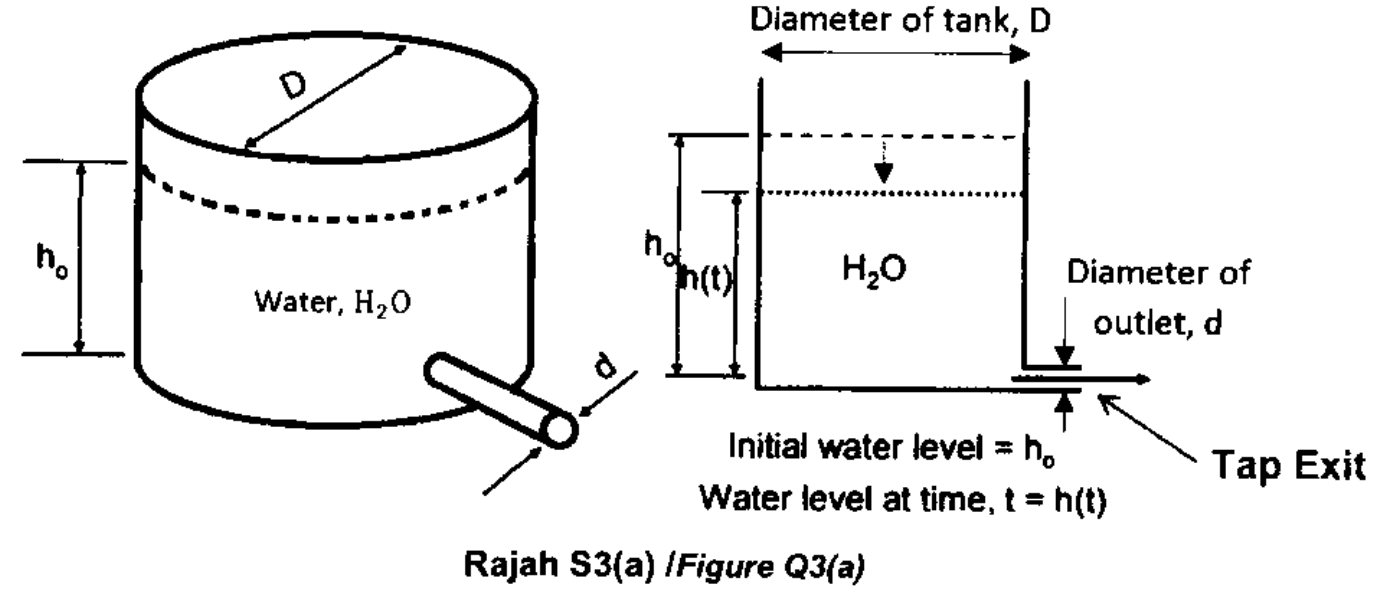
The water draining process from a tank is governed by the following equation:
dtdh=−2gh(Dd)2
where the g is the gravity coefficient (i.e. 9.81 m/s) and h is the height of
water level function measured from the ground level. The diameter of the tank, D is
5.6 m and its outlet's diameter, d is 0.1 m.
Units in the printed paper
The paper writes the gravitational acceleration as "9.81 m/s" in both Q3(a) and Q3(b),
which is a velocity unit; the correct unit is m/s2. The value g=9.81 m/s2 is
used throughout the solutions below.
(i) Given the initial height, h0 of the water level is 4.0 m, suggest a suitable strategy
and use it to calculate the height of water level function in the tank over time, h(t)
as shown in Figure Q3(a).
Solution
Strategy: separation of variables. The right-hand side depends only on h and the
left-hand side only on t, so the ODE is separable (the equation is autonomous with
2g(d/D)2 a constant).
Write k=2g(Dd)2 so that dtdh=−kh, and
separate:
hdh=−kdt.
Integrate both sides:
∫h−1/2dh=−k∫dt⟹2h=−kt+C.
Apply the initial condition h(0)=h0=4.0 m:
24.0=C⟹C=4.
Hence
h=2−2kt=2−212g(Dd)2t,
and squaring gives the height as a function of time:
h(t)=[2−212g(Dd)2t]2.
Numerical form. With g=9.81, d=0.1, D=5.6:
2g=19.62≈4.4294,(Dd)2=(5.60.1)2=31361≈3.1888×10−4212g(Dd)2=21(4.4294)(3.1888×10⁻⁴)≈7.0624×10⁻⁴m1/2s−1h(t)≈(2−7.0624×10−4t)2 m.
Verification. Differentiating, dtdh=−2(7.0624×10⁻⁴)(2−7.0624×10⁻⁴t)=−2g(Dd)2h, which is the original ODE. Also h(0)=4.0 m. ✓
Answer:h(t)=[2−212g(Dd)2t]2, i.e.
h(t)≈(2−7.062×10⁻⁴t)2 m (valid for 0≤t≤2832 s).
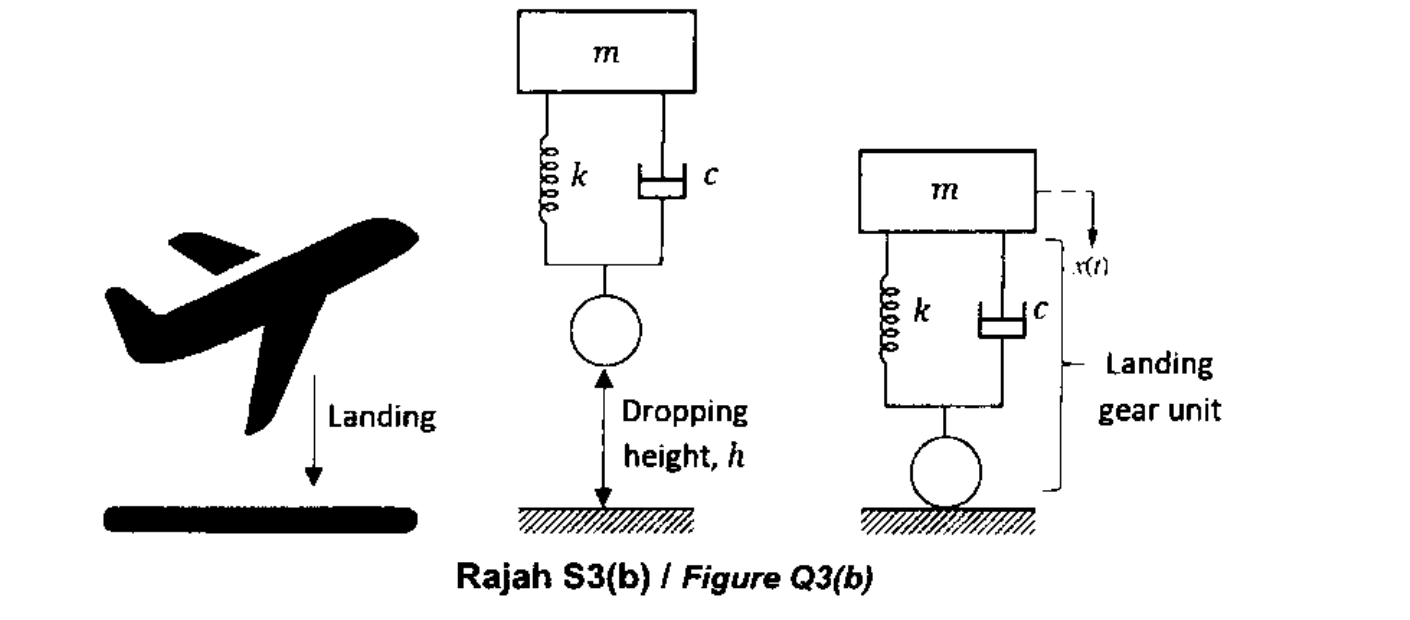
The landing-gear unit of an airplane is examined under drop test to ensure a safety and
comfort landing, as shown in Figure Q3(b). The vibration at the airplane body, x(t) due to
the dropping height, h can be governed by the simplified equation:
mx¨+cx˙+kx=F(t)
where m is the equivalent mass of the airplane, c and k are the damping and stiffness
coefficients respectively of the landing-gear unit. x, x˙ and x¨ are the
displacement, velocity and acceleration of the mass respectively. F(t)=mg is the forcing
function where g is the gravity coefficient (i.e. 9.81 m/s).
Given the dropping height of the testing is h=5.10 m, determine the impact velocity at
ground and the total vibration, x(t) experienced by the airplane in this condition.
Impact velocity. The body falls freely through h=5.10 m from rest, so at the moment
of impact
v0=2gh=2(9.81)(5.10)=100.062≈10.003 m/s.
This is exactly the initial condition x˙(0)=2gh supplied in the question.
Reduce the ODE. Divide the whole equation by m=60000:
x¨+2x˙+50x=g=9.81.
This is a linear second-order ODE with constant coefficients (forced, underdamped).
Complementary function. The auxiliary equation is
r2+2r+50=0⟹r=2−2±4−200=−1±−49=−1±7i.
Using Euler's formula e(−1±7i)t=e−t(cos7t±isin7t), the
complementary function is
xc(t)=e−t(Acos7t+Bsin7t),
with damped natural frequency ωd=7 rad/s and damping ratio
ζ=c/(2mk)=1/50≈0.141 (underdamped).
Particular integral. The forcing is the constant mg, so try xp=X constant:
0+0+50X=9.81⟹X=509.81=0.1962.
General solution.
x(t)=0.1962+e−t(Acos7t+Bsin7t).
Apply the initial conditions. First, x(0)=0:
0.1962+A=0⟹A=−0.1962.
Differentiate:
x˙(t)=−e−t(Acos7t+Bsin7t)+e−t(−7Asin7t+7Bcos7t).
At t=0, using v0=10.003:
x˙(0)=−A+7B=0.1962+7B=10.003⟹7B=9.8068⟹B=1.4010.
Total vibration.
x(t)=0.1962+e−t(−0.1962cos7t+1.4010sin7t) m.
Equivalently, combining the two harmonic terms into a single sine with amplitude
R=A2+B2=0.19622+1.40102≈1.4147 m and phase
δ=arctan(A/B)≈−0.139 rad:
x(t)≈0.1962+1.4147e−tsin(7t−0.139) m.
Check.x(0)=0.1962−0.1962=0✓ and x˙(0)=0.1962+7(1.4010)=10.003 m/s ✓
Answer: Impact velocity v0=2gh=100.062≈10.00 m/s;
total vibration
x(t)=0.1962+e−t(−0.1962cos7t+1.401sin7t) m
≈0.1962+1.415e−tsin(7t−0.139) m.
Given two ordinary differential equations as follow:
2x2y′′+3xy′−(x2+1)y=0(4a)y′′−xy′−x2y=0(4b)
For each equation, determine the characteristic of the point x=0. Based on the results
obtained, find either (a) or (b) for each equation.
(a) Two linearly independent solutions using the Power Series Method at the point x=0 (9 marks)
(b) The indicial roots using the Frobenius Method at the point x=0 plus determine whether two linearly independent Frobenius solutions can be found (6 marks)
Classification of x=0.
Write each equation in the standard form y′′+P(x)y′+Q(x)y=0 and test whether xP(x)
and x2Q(x) are analytic at x=0.
Equation (4a). Dividing by 2x2,
P(x)=2x3,Q(x)=−2x2x2+1.
P and Q are singular at x=0, but
xP(x)=23,x2Q(x)=−2x2+1
are both analytic (indeed polynomial) at x=0. Hence x=0 is a regular singular point
of (4a), so the Frobenius method (part b) applies.
Equation (4b). Here
P(x)=−x,Q(x)=−x2
are both analytic at x=0 (they are polynomials), so x=0 is an ordinary point of
(4b) and the power series method (part a) applies.
Hence y1 and y2 are linearly independent, and the general solution is
y=c1y1+c2y2 with c1, c2 arbitrary constants. Because P(x)=−x and
Q(x)=−x2 are entire, both series converge for all x.
Check (substitution of the first few terms). Substituting the truncated series back into
y′′−xy′−x2y leaves −90720571x10−11340041x12+⋯, i.e. terms of order x10 and higher — the first two terms beyond those the recurrence determines — confirming the recurrence.
Can two linearly independent Frobenius solutions be found?
The two indicial roots are
r1−r2=21−(−1)=23.
Since the difference of the indicial roots is not an integer, Frobenius theory guarantees
that the two series above are genuinely linearly independent (neither is a constant multiple of
the other, and no logarithmic term is required). Their Wronskian is non-zero for x>0, so
the general solution on x>0 is
Check. Substituting the truncated series into
2x2y′′+3xy′−(x2+1)y leaves only the first omitted term
(−x17/2/55440 for r1 and −x7/2160 for r2), confirming both recurrences.
Answer: Indicial roots r1=21 and r2=−1 (from 2r2+r−1=0).
Because r1−r2=23 is not an integer, two linearly independent Frobenius
solutions can be found:
These solutions are written for revision purposes and are not official examiner solutions.
If you spot an error, please email us at kix1001 [at] hongvin.xyz.