Academic session 2020/2021, Semester 1 · 2 questions · 6 printed pages · 1.5 hours.
Questions are reproduced in English from the bilingual original. Solutions are worked in
full; numbers are given to a sensible precision.
Set selection — read this first
For Questions 1 and 2, students are divided into 3 groups, and each group should solve
only its own set of questions:
Set
Student ID ending with
Set 1
0, 3, 6 and 8
Set 2
4, 1 and 9
Set 3
7, 5 and 2
The printed paper contains only one version of Questions 1 and 2: pages 3–6 carry a single
set of parts, 1(a)–(c) and 2(a)–(b), and no set-specific variants are printed anywhere in the
paper. The three sets therefore differ only in which student ID numbers are told to attempt
them — not in the questions themselves. The solutions below are the answers for all three
sets.
Reference only — these are not official answers
These solutions are revision aids, not examiner answers. They were produced with the
help of a large language model and then checked, but an LLM can still be wrong:
expect the occasional arithmetic slip, a different method than your lecturer's, or a
misreading of the printed question. The question wording is reproduced by hand from a scan
of the original paper, so it too may differ in small ways from what was printed.
Use this page as a worked suggestion to check, not as ground truth. Always compare
against the original paper (linked above) and your own lecture notes, and if something here
disagrees with your lecturer, trust your lecturer. Marks shown are the paper's allocations,
not a marking scheme.
A hyperboloid of one sheet is constructed by connecting two concentric vertically offset rings
with tilted wires in the construction of power plant's cooling tower. In order to analyze the
force acting on the cooling tower, determine the equation of tangent plane and normal plane at
the point (2,4,6). The support function of the hyperboloid of one sheet structure is
52x2+32y2−22z2=1
Solution
Technique. Write the surface as a level surface F(x,y,z)=0. The gradient ∇F is
normal to the surface, so the tangent plane at a point P is ∇F(P)⋅[(x,y,z)−P]=0, and the normal line is (x,y,z)=P+t∇F(P).
Step 3 — normal line. The normal line passes through P with direction ∇F(P)=(254,98,−3), i.e. with direction proportional to (36,200,−675):
4/25x−2=8/9y−4=−3z−6⟺36x−2=200y−4=−675z−6,
or in parametric form
(x,y,z)=(2,4,6)+t(254,98,−3),t∈R.
Printing check on the given point
Substituting (2,4,6) into the printed support function gives
254+916−436=−2251589≈−7.06=1,
so the printed point does not lie on the printed hyperboloid. The standard tangent-plane
formula has nevertheless been applied at the printed point: it gives the tangent plane of the
level surface F=−1814/225 that does pass through (2,4,6), using the normal direction
∇F(2,4,6). Had the point been on the surface, only the constant term would change.
About the "normal plane"
The paper asks for the "normal plane". For a surface the object normally intended is the
normal line — the line through the point in the direction of ∇F — and that is what is
given above. (The only plane through the point whose normal vector is ∇F is the tangent
plane itself, so a separate "normal plane" would carry no extra information.)
:::
Answer: Tangent plane 36x+200y−675z+3178=0, equivalently 254(x−2)+98(y−4)−3(z−6)=0. Normal line 36x−2=200y−4=−675z−6 (direction (36,200,−675)).
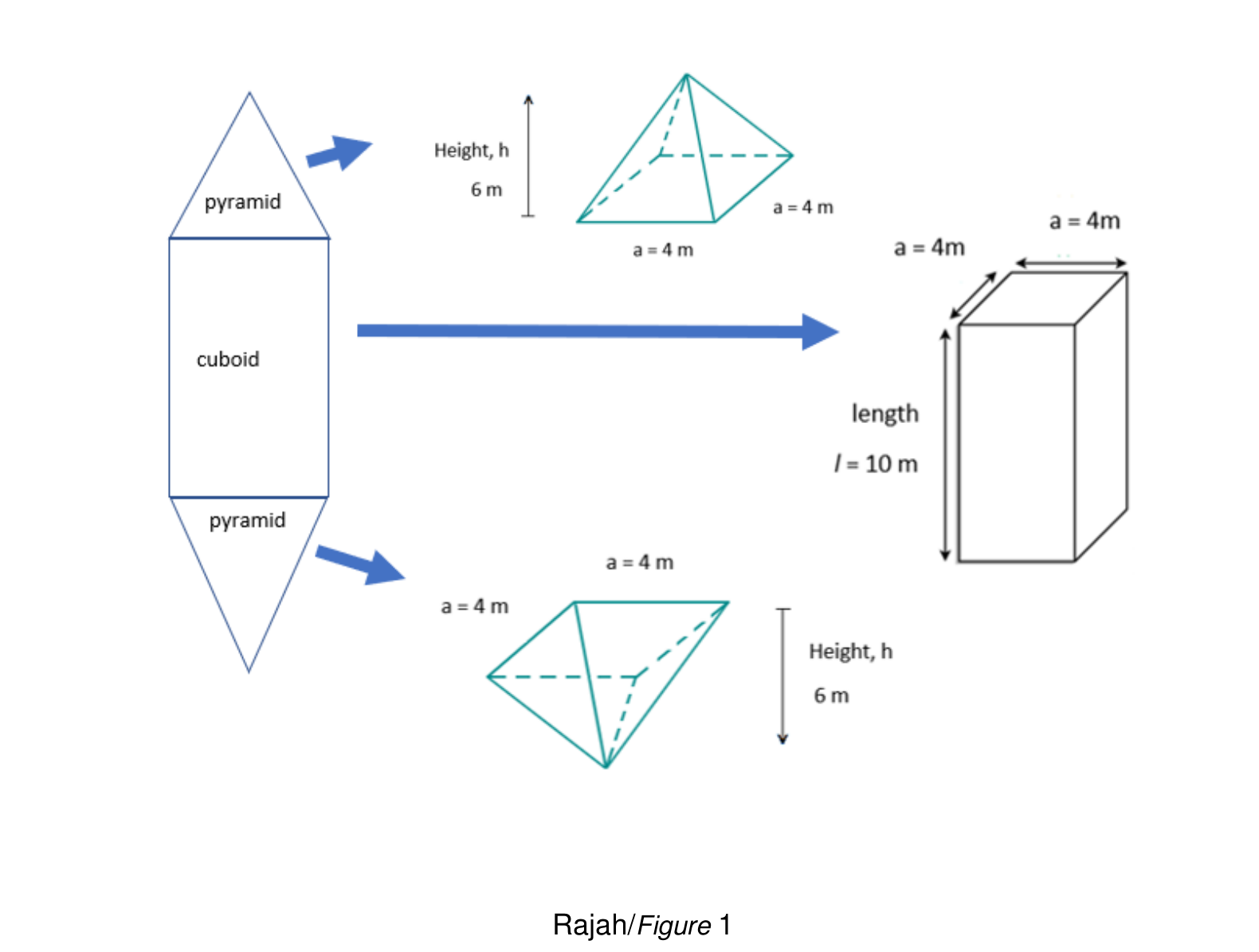
As a structure engineer, you are required to design a stable structure in the form of cuboid
and surrounded by pyramid ends. In order to analyze the stability of the structure, determine the
percentage change in volume of the structure. Given that the width, a of 4 m is increased by
0.01 m, while the length, l of 10 m is increased by 0.02 m and the height, h of 6 m is
increased by 0.03 m. Please Refer Figure 1.
Solution
Technique. Use the total differential of a function of three variables, dV=∂a∂Vda+∂l∂Vdl+∂h∂Vdh, and divide by V to get the percentage change.
Step 1 — volume of the structure. From Figure 1 the structure is a cuboid of cross-section a×a and length l, capped at both ends by square pyramids of base a and height h:
Step 4 — percentage change. The original volume is
V=a2l+32a2h=16(10)+32(16)(6)=160+64=224m3.
Hence
VdV×100%=2241.76×100%=1411%≈0.786%.
Step 5 — exact check. Using the new dimensions a=4.01, l=10.02, h=6.03:
V′=(4.01)2(10.02)+32(4.01)2(6.03)=225.7646m3,
so the true increase is 225.7646−224=1.7646m3, i.e. 0.788%. The linear (total-differential) estimate 0.786% is therefore accurate to three significant figures, as expected for such small increments.
Answer:dV=1.76m3 out of V=224m3, a percentage increase of 1411%≈0.786% (exact value from the new dimensions: 0.788%).
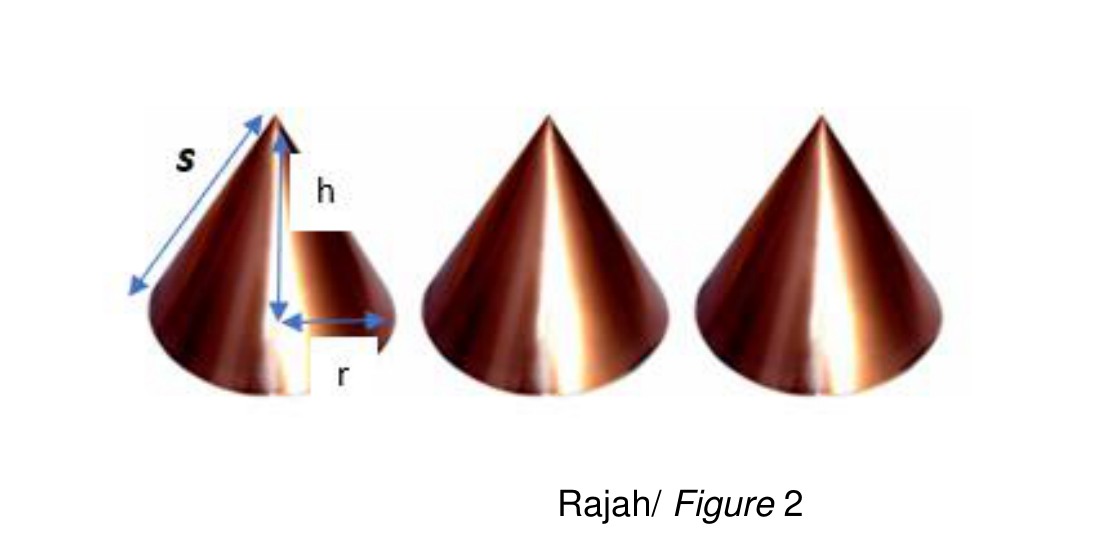
You are a manufacturer of metal cones. In order to minimize the material used in the
manufacturing process, you need to fabricate the metal cones shown below. You are provided with
3 copper cones with total volume of 15 m³. Each cone consists of the flat base surface and
lateral surface. Determine the possible dimensions of the lateral surface for each cone to
estimate the amount of copper material needed to construct each cone's lateral surface. (Given
the dimensions of cone are height of the cone, h, the slant length, s, and the radius of the
base, r). Refer Figure 2.
Solution
Technique. This is a constrained optimisation: minimise the lateral surface area A=πrs subject to a fixed volume, using Lagrange multipliers (one constraint).
Step 1 — set up. For one cone, s=r2+h2, so the material needed for the lateral surface is A(r,h)=πrr2+h2, and the volume constraint (each cone carries 15/3=5m3) is g(r,h)=31πr2h−5=0.
Step 6 — confirm this is a minimum. Eliminating h with h=πr215 gives
A(r)=πrr2+π2r4225,A(r)→∞asr→0+and asr→∞.
The single stationary point r=(2π152)1/3 is therefore the global minimum of A. The optimum has the classic shape h=2r (apex angle 2arctan(r/h)≈70.5∘).
Assumption about the three cones
The paper gives only the total volume of the three cones, 15m3; the cones are taken
to be identical, so each carries 5m3. (If the volume were free to be shared
unequally, the total lateral area would be minimised by loading all 15m3 into a single
cone, since A∝V2/3 is concave — not a physical design. The intended reading is three
equal cones, so each has volume 5m3.)
:::
Answer: Each cone: radius r=(2π152)1/3≈1.500m, height h=2r=(π30)1/3≈2.122m and slant length s=r3≈2.598m, giving a lateral surface area of πrs≈12.25m2 per cone and ≈36.74m2 of copper for all three cones.
give the distortion induced by the transformation and the corresponding eigenvectors
2−11−12−11−12
are the orientation of the distortion according to AX=λX where, λ is the eigenvalues and X is the corresponding eigenvectors. Find matrix A before the distortion happened.
Solution
Technique. The columns of the eigenvector matrix are the eigenvectors, so with P=2−11−12−11−12 (columns X1,X2,X3) and D=diag(2,−5,7) we have AP=PD, hence A=PDP−1.
As a consultant engineer, you need to consult a client on the cost of repairing a gas pipeline.
You have come out with proposal A, B and C. For proposal A, the installation cost is triple, the
material cost is double and the painting cost is triple. The total cost of the repairment is
RM 10 000. For proposal B, the installation cost is double, the material cost is 5 times more
expensive and the painting cost is double. The total cost of the repairment is RM 12 000. For
proposal C, the installation cost is cheaper by 1/3 in comparison to proposal A, the material
cost is triple and the painting cost is double. The total cost of the repairment is RM 8 000.
Find the installation cost, material cost and painting cost for each of the proposal
respectively using Cramer's Rule.
Solution
Technique. Let I, M and P be the base installation, material and painting costs. Each proposal gives one linear equation (the multipliers of the base costs are the coefficients), so we have a 3×3 system to be solved by Cramer's ruleI=detAdetAI, M=detAdetAM, P=detAdetAP.
Step 1 — build the system exactly as printed.
Proposal
Installation
Material
Painting
Total (RM)
A
3I
2M
3P
10 000
B
2I
5M
2P
12 000
C
2I
3M
2P
8 000
A=322253322,b=10000120008000.
Step 2 — the printed coefficients are singular. Expanding along the first row,
detA=3(10−6)−2(4−4)+3(6−10)=12−0−12=0.
Cramer's rule cannot be applied, and the system is in fact inconsistent: the first row satisfies (3,2,3)=−45(2,5,2)+411(2,3,2), but the right-hand sides give −45(12000)+411(8000)=−15000+22000=7000=10000. So no triple (I,M,P) satisfies all three printed equations — see the note below for the reading adopted.
Step 3 — solve the corrected system by Cramer's rule. Reading proposal B's painting cost as triple (coefficient 3), which keeps the installation column 3,2,2 that the question fixes explicitly:
Step 4 — cost of each proposal. Applying that proposal's multipliers to the base costs:
Proposal
Installation
Material
Painting
Total (RM)
A
3(400)=1200
2(800)=1600
3(2400)=7200
10 000 ✔
B
2(400)=800
5(800)=4000
3(2400)=7200
12 000 ✔
C
2(400)=800
3(800)=2400
2(2400)=4800
8 000 ✔
All three printed totals are reproduced exactly.
Printing error in proposal B
The printed data are inconsistent. Proposals A and C as printed are mutually consistent and force M=800 and I+P=2800; proposal B as printed would then need 2I+5M+2P=2(2800)+4000=9600, not the printed RM 12 000, and its coefficient row (2,5,2) is parallel to the other two rows, so detA=0.
One coefficient of proposal B must therefore be 3, not 2. The solution above takes proposal B's painting cost as triple (3), because the installation column 3,2,2 is fixed explicitly by the wording (A triple, B double, C "cheaper by 1/3 in comparison to A", i.e. 3×32=2). Under the other equally plausible single-entry correction — proposal B's installation cost triple, giving rows (3,2,3), (3,5,2), (2,3,2) and detA=5 — the solution is instead I=RM 2400, M=RM 800, P=RM 400, with proposal costs A: 7200, 1600, 1200; B: 7200, 4000, 800; C: 4800, 2400, 800. Note that in both readings M=RM 800 and the printed A and C totals are satisfied exactly; only the split of the RM 2800 between I and P depends on which figure in proposal B is corrected.
:::
Answer: Installation I=RM 400, material M=RM 800, painting P=RM 2400 per unit of the multipliers, i.e.
Proposal A — installation RM 1 200, material RM 1 600, painting RM 7 200 (total RM 10 000);
Proposal B — installation RM 800, material RM 4 000, painting RM 7 200 (total RM 12 000);
Proposal C — installation RM 800, material RM 2 400, painting RM 4 800 (total RM 8 000).