Tutorial 1

Tutorial 1: Functions, Derivatives & Engineering Applications

  1. Evaluate the limit for the following if it exists:

    a. lim⁡x→5x2−25x2+x−30\displaystyle \lim _{x \rightarrow 5} \frac{x^{2}-25}{x^{2}+x-30}

    Solution
    lim⁡x→5x2−25x2+x−30=lim⁡x→5(x−5)(x+5)(x−5)(x+6)=lim⁡x→5(x+5)(x+6)=(5+5)(5+6)=1011\begin{aligned} \lim _{x \rightarrow 5} \frac{x^{2}-25}{x^{2}+x-30} &=\lim _{x \rightarrow 5} \frac{(x-5)(x+5)}{(x-5)(x+6)}\\ &=\lim _{x \rightarrow 5} \frac{(x+5)}{(x+6)}\\ &=\frac{(5+5)}{(5+6)}\\ &=\frac{10}{11} \end{aligned}

    b. lim⁡x→9x−3x−9\displaystyle \lim _{x \rightarrow 9} \frac{\sqrt{x}-3}{x-9}

    Solution
    lim⁡x→9x−3x−9=lim⁡x→9(x−3)(x+3)(x−9)(x+3)=lim⁡x→9(x−9)(x−9)(x+3)=lim⁡x→91(x+3)=1(9+3)=16\begin{aligned} \lim _{x \rightarrow 9} \frac{\sqrt{x}-3}{x-9} &=\lim _{x \rightarrow 9} \frac{(\sqrt{x}-3)(\sqrt{x}+3)}{(x-9)(\sqrt{x}+3)}\\ &=\lim _{x \rightarrow 9} \frac{(x-9)}{(x-9)(\sqrt{x}+3)}\\ &=\lim _{x \rightarrow 9} \frac{1}{(\sqrt{x}+3)}\\ &=\frac{1}{(\sqrt{9}+3)}\\ &=\frac{1}{6} \end{aligned}

    c. lim⁡x→0x3−x+9\displaystyle \lim _{x \rightarrow 0} \frac{x}{3-\sqrt{x+9}}

    Solution
    lim⁡x→0x3−x+9=lim⁡x→0x(3−x+9)(3+x+9)(3+x+9)=lim⁡x→0x(3+x+9)9−(x+9)=lim⁡x→0x(3+x+9)−x=lim⁡x→03+x+9−1=−6\begin{aligned} \lim _{x \rightarrow 0} \frac{x}{3-\sqrt{x+9}} &=\lim _{x \rightarrow 0} \frac{x}{(3-\sqrt{x+9)}} \frac{(3+\sqrt{x+9})}{(3+\sqrt{x+9)}}\\ &=\lim _{x \rightarrow 0} \frac{x(3+\sqrt{x+9})}{9-(x+9)}\\ &=\lim _{x \rightarrow 0} \frac{x(3+\sqrt{x+9})}{-x}\\ &=\lim _{x \rightarrow 0} \frac{3+\sqrt{x+9}}{-1}\\ &=-6 \end{aligned}
  1. Find the derivative of log⁡(4+cos⁡x)\log(4+\cos x).

    Solution
    D(log⁡x)=1xlog⁡e=1xln⁡10D[log⁡(4+cos⁡x)]=14+cos⁡x(log⁡e)D(4+cos⁡x)=14+cos⁡x(log⁡e)(−sin⁡x)=−(log⁡e)(sin⁡x)4+cos⁡x\begin{aligned} D(\log x) &=\frac{1}{x} \log e=\frac{1}{x \ln 10} \\ D[\log (4+\cos x)] &=\frac{1}{4+\cos x}(\log e) D(4+\cos x)\\ &=\frac{1}{4+\cos x}(\log e)(-\sin x)\\ &=\frac{-(\log e)(\sin x)}{4+\cos x} \end{aligned}
  1. Find dydx\frac{dy}{dx} for cos⁡(x2)=xey\cos(x^2)=xe^y.

    Solution
    cos⁡(x2)=xey−sin⁡(x2)⋅2x=xeydydx+eyxeydydx=−2xsin⁡(x2)−eydydx=−2xsin⁡(x2)−eyxey\begin{aligned} \cos \left(x^{2}\right) &=x e^{y} \\ -\sin \left(x^{2}\right) \cdot 2 x &=x e^{y} \frac{d y}{d x}+e^{y}\\ x e^{y} \frac{d y}{d x} &=-2 x \sin \left(x^{2}\right)-e^{y} \\ \frac{d y}{d x} &=\frac{-2 x \sin \left(x^{2}\right)-e^{y}}{x e^{y}} \end{aligned}
  2. Find dydx\frac{dy}{dx} for x3y3−2y=xx^3y^3-2y=x.

    Solution
    x3[3y2(dydx)]+y3[3x2]−2(dydx)=13x3y2(dydx)+3x2y3−2(dydx)=13x3y2(dydx)−2(dydx)=1−3x2y3dydx=1−3x2y33x3y2−2\begin{aligned} x^{3}\left[3 y^{2}\left(\frac{d y}{d x}\right)\right]+y^{3}\left[3 x^{2}\right]-2\left(\frac{d y}{d x}\right)&=1 \\ 3 x^{3} y^{2}\left(\frac{d y}{d x}\right)+3 x^{2} y^{3}-2\left(\frac{d y}{d x}\right)&=1 \\ 3 x^{3} y^{2}\left(\frac{d y}{d x}\right)-2\left(\frac{d y}{d x}\right)&=1-3 x^{2} y^{3} \\ \frac{d y}{d x}&=\frac{1-3 x^{2} y^{3}}{3 x^{3} y^{2}-2} \end{aligned}
  3. A curve in the plane is defined parametrically by the equations x=7ln⁡(t)x=7\ln(t) and y=1−4ty=\sqrt{1-4t}. Find dydx\frac{dy}{dx}.

    Solution
    dydx=(dydt)(dxdt)=ddt(1−4t)ddt(7ln⁡(t))=12(1−4t)−12⋅(−4)7t=−2t71−4t\begin{aligned} \frac{d y}{d x}&=\frac{\left(\frac{d y}{d t}\right)}{\left(\frac{d x}{d t}\right)}\\ &=\frac{\frac{d}{d t}(\sqrt{1-4 t})}{\frac{d}{d t}(7 \ln (t))}\\ &=\frac{\frac{1}{2}(1-4 t)^{-\frac{1}{2}} \cdot(-4)}{\frac{7}{t}}\\ &=-\frac{2 t}{7 \sqrt{1-4 t}} \end{aligned}
  4. A curve in the plane is defined parametrically by the equations x=t2−1x=t^2-1 and y=2ety=2e^t. Find dydx\frac{dy}{dx}.

    Solution
    dydx=(dydt)(dxdt)=ddt(2et)ddt(t2−1)=2et2t=ett\begin{aligned} \frac{d y}{d x}&=\frac{\left(\frac{d y}{d t}\right)}{\left(\frac{d x}{d t}\right)}\\ &=\frac{\frac{d}{d t}\left(2 e^{t}\right)}{\frac{d}{d t}\left(t^{2}-1\right)}\\ &=\frac{2 e^{t}}{2 t}=\frac{e^{t}}{t} \end{aligned}
  5. Find y′y' for each of the following:

    a. x2tan⁡(y)+y10sec⁡(x)=2xx^2\tan(y)+y^{10}\sec(x)=2x

    Solution
    2xtan⁡(y)+x2sec⁡2(y)y′+10y9y′sec⁡(x)+y10sec⁡(x)tan⁡(x)=2(x2sec⁡2(y)+10y9sec⁡(x))y′=2−y10sec⁡(x)tan⁡(x)−2xtan⁡(y)y′=2−y10sec⁡(x)tan⁡(x)−2xtan⁡(y)x2sec⁡2(y)+10y9sec⁡(x)\begin{aligned} 2 x \tan (y)+x^{2} \sec ^{2}(y) y^{\prime}&+10 y^{9} y^{\prime} \sec (x)+y^{10} \sec (x) \tan (x)=2 \\ \left(x^{2} \sec ^{2}(y)+10 y^{9} \sec (x)\right) y^{\prime}&=2-y^{10} \sec (x) \tan (x)-2 x \tan (y) \\ y^{\prime}&=\frac{2-y^{10} \sec (x) \tan (x)-2 x \tan (y)}{x^{2} \sec ^{2}(y)+10 y^{9} \sec (x)} \end{aligned}

    b. x3y5+3x=8y3+1x^3y^5+3x=8y^3+1

    Solution
    3x2y5+5x3y4y′+3=24y2y′3x2y5+3=24y2y′−5x3y4y′y′=3x2y5+324y2−5x3y4\begin{aligned} 3 x^{2} y^{5}+5 x^{3} y^{4} y^{\prime}+3&=24 y^{2} y^{\prime} \\ 3 x^{2} y^{5}+3&=24 y^{2} y^{\prime}-5 x^{3} y^{4} y^{\prime} \\ y^{\prime}&=\frac{3 x^{2} y^{5}+3}{24 y^{2}-5 x^{3} y^{4}} \end{aligned}

    c. e2x+3y=x2−ln⁡(xy3)e^{2x+3y}=x^2-\ln(xy^3)

    Solution
    2e2x+3y+3y′e2x+3y=2x−y3xy3−3xy2y′xy32e2x+3y+3y′e2x+3y=2x−1x−3y′y(3e2x+3y+3y−1)y′=2x−x−1−2e2x+3yy′=2x−x−1−2e2x+3y3e2x+3y+3y−1\begin{aligned} 2 e^{2 x+3 y}+3 y^{\prime} e^{2 x+3 y}&=2 x-\frac{y^{3}}{x y^{3}}-\frac{3 x y^{2} y^{\prime}}{x y^{3}} \\ 2 e^{2 x+3 y}+3 y^{\prime} e^{2 x+3 y}&=2 x-\frac{1}{x}-\frac{3 y^{\prime}}{y} \\ \left(3 e^{2 x+3 y}+3 y^{-1}\right) y^{\prime}&=2 x-x^{-1}-2 e^{2 x+3 y} \\ y^{\prime}&=\frac{2 x-x^{-1}-2 e^{2 x+3 y}}{3 e^{2 x+3 y}+3 y^{-1}} \end{aligned}
  6. Solve for y′y' if y=ln⁡(cos⁡x2)y=\ln(\cos x^2).

    Solution

    Let u=cos⁡x2u=\cos x^{2}, then dudx=(−sin⁡x2)(2x)\frac{d u}{d x}=\left(-\sin x^{2}\right)(2 x),

    y=ln⁡u, then dydu=1uy=\ln u, \text { then } \frac{d y}{d u}=\frac{1}{u}

    dydx=(1u)(−sin⁡x2)(2x)=−2xsin⁡x2cos⁡x2=−2xtan⁡x2\begin{aligned} \frac{d y}{d x}&=\left(\frac{1}{u}\right)\left(-\sin x^{2}\right)(2 x)\\ &=-\frac{2 x \sin x^{2}}{\cos x^{2}}\\ &=-2 x \tan x^{2} \end{aligned}
  7. Find y′y' for 10e2xy=e15y+e13x10e^{2xy}=e^{15y}+e^{13x}.

    Solution
    10e2xy=e15y+e13x10e2xy(2xy′+2y)=e15y(15y′)+e13x(13)10e2xy(2xy′+2y)=15y′e15y+13e13x(20xe2xy−15e15y)y′=13e13x−20ye2xyy′=13e13x−20ye2xy20xe2xy−15e15y\begin{aligned} 10 e^{2 x y}&=e^{15 y}+e^{13 x}\\ 10 e^{2 x y}\left(2 x y^{\prime}+2 y\right)&=e^{15 y}\left(15 y^{\prime}\right)+e^{13 x}(13)\\ 10 e^{2 x y}\left(2 x y^{\prime}+2 y\right)&=15 y^{\prime} e^{15 y}+13 e^{13 x} \\ \left(20 x e^{2 x y}-15 e^{15 y}\right) y^{\prime}&=13 e^{13 x}-20 y e^{2 x y} \\ y^{\prime}&=\frac{13 e^{13 x}-20 y e^{2 x y}}{20 x e^{2 x y}-15 e^{15 y}} \end{aligned}
  8. Solve f′(x)f'(x) if f(x)=2x(arctan⁡5x)2+6tan⁡(cos⁡6x)f(x)=2x(\arctan 5x)^2+6\tan(\cos 6x).

    Solution

    f(x)=2x(arctan⁡5x)2+6tan⁡(cos⁡6x)f(x)=2 x(\arctan 5 x)^{2}+6 \tan (\cos 6 x) ddx(tan⁡−15x)2=2tan⁡−15x(11+(5x)2)(5)=10tan⁡−15x1+25x2\frac{d}{d x}\left(\tan ^{-1} 5 x\right)^{2}=2 \tan ^{-1} 5 x\left(\frac{1}{1+(5 x)^{2}}\right)(5)=\frac{10 \tan ^{-1} 5 x}{1+25 x^{2}} ddx2x(tan⁡−15x)2=2x(10tan⁡−15x1+25x2)+(tan⁡−15x)2(2)=20xtan⁡−15x1+25x2+2(tan⁡−15x)2\begin{aligned} \frac{d}{d x} 2 x\left(\tan ^{-1} 5 x\right)^{2}&=2 x\left(\frac{10 \tan ^{-1} 5 x}{1+25 x^{2}}\right)+\left(\tan ^{-1} 5 x\right)^{2}(2)\\ &=\frac{20 x \tan ^{-1} 5 x}{1+25 x^{2}}+2\left(\tan ^{-1} 5 x\right)^{2} \end{aligned} ddx6tan⁡(cos⁡6x)=6sec⁡2(cos⁡6x)ddxcos⁡6x=6sec⁡2(cos⁡6x)×(−sin⁡6x)×6=−36(sec⁡2(cos⁡6x))sin⁡6x\begin{aligned} \frac{d}{d x} 6 \tan (\cos 6 x)&=6 \sec ^{2}(\cos 6 x) \frac{d}{d x} \cos 6 x\\ & =6 \sec ^{2}(\cos 6 x) \times(-\sin 6 x) \times 6 \\ & =-36\left(\sec ^{2}(\cos 6 x)\right) \sin 6 x \end{aligned}

    Therefore, f′(x)=20xtan⁡−15x1+25x2+2(tan⁡−15x)2−36(sec⁡2(cos⁡6x))sin⁡6xf^{\prime}(x)=\frac{20 x \tan ^{-1} 5 x}{1+25 x^{2}}+2\left(\tan ^{-1} 5 x\right)^{2}-36\left(\sec ^{2}(\cos 6 x)\right) \sin 6 x

  9. Solve y′y' if y=4xsinh⁡−1(x6)+tanh⁡−1(cos⁡10x)y=4x\sinh^{-1}(\frac{x}{6})+\tanh^{-1}(\cos 10x).

    Solution
    ddx4xsinh⁡−1(x6)=4x[11+(x6)2⋅16]+4sinh⁡−1(x6)=2x31+x236+4sinh⁡−1(x6)\begin{aligned}\frac{d}{d x} 4 x \sinh ^{-1}\left(\frac{x}{6}\right)&=4 x\left[\frac{1}{\sqrt{1+\left(\frac{x}{6}\right)^{2}}} \cdot \frac{1}{6}\right]+4 \sinh ^{-1}\left(\frac{x}{6}\right)\\ &=\frac{\frac{2 x}{3}}{\sqrt{1+\frac{x^{2}}{36}}}+4 \sinh ^{-1}\left(\frac{x}{6}\right) \end{aligned}
    ddxtanh⁡−1(cos⁡10x)=11−(cos⁡10x)2(ddxcos⁡10x)=11−(cos⁡10x)2(−10sin⁡10x)=−10sin⁡10x1−cos⁡210x=−10sin⁡10xsin⁡210x=−10sin⁡10x=−10csc⁡10x\begin{aligned} \frac{d}{d x} \tanh ^{-1}(\cos 10 x) \quad &=\frac{1}{1-(\cos 10 x)^{2}}\left(\frac{d}{d x} \cos 10 x\right)\\ &=\frac{1}{1-(\cos 10 x)^{2}}(-10 \sin 10 x) \\ &=\frac{-10 \sin 10 x}{1-\cos ^{2} 10 x} \\ &=-\frac{10 \sin 10 x}{\sin ^{2} 10 x} \\ &=-\frac{10}{\sin 10 x}\\ &=-10 \csc 10 x \end{aligned}
    ∴f′(x)=2x31+x236+4sinh⁡−1(x6)−10csc⁡10x\begin{aligned} \therefore f'(x)=\frac{\frac{2x}{3}}{\sqrt{1+\frac{x^2}{36}}}+4\sinh^{-1}{(\frac{x}{6})}-10\csc{10x} \end{aligned}
  10. The engineering discipline of piping design studies the efficient transport of fluid. You are required to design a stable pipe that can hold 200 litres of fluid at a time. Assuming that it is a closed ended pipe at both ends, determine the dimensions (radius and height in cm) of the pipe that will minimize the amount of material used to construct the pipe with justification.
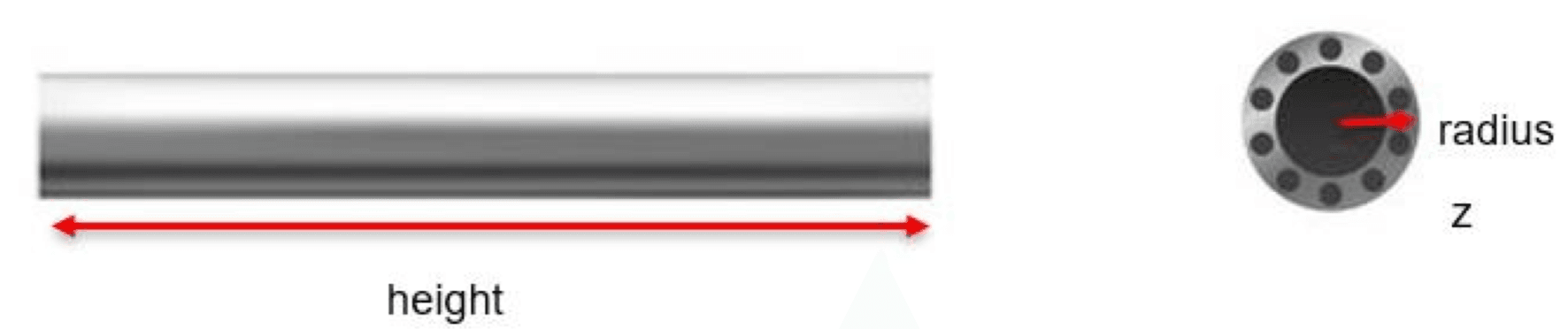
    Figure for Question 12
    Solution
    A=2πr2+2πrhπr2h=200,000⇒h=200,000πr2\begin{align} A&=2\pi r^2+2\pi r h \\ \pi r^2 h&= 200,000 \quad \Rightarrow h=\frac{200,000}{\pi r^2} \end{align}
    A(r)=2πr2+400,000rA′(r)=4πr−400,000r2\begin{aligned} A(r) &= 2\pi r^2 + \frac{400,000}{r} \\ A'(r) &= 4\pi r - \frac{400,000}{r^2} \end{aligned}

    Find critical number, A′(r)=0A'(r)=0, Radius, r=31.7 cm\text{Radius, }r = 31.7\text{ cm}

    A′′(r)=4π+800,000r3A''(r)=4\pi + \frac{800,000}{r^3} → +ve → concavity: concave upward → min point.

    Hence h=63.3 cmh = 63.3 \text{ cm}.

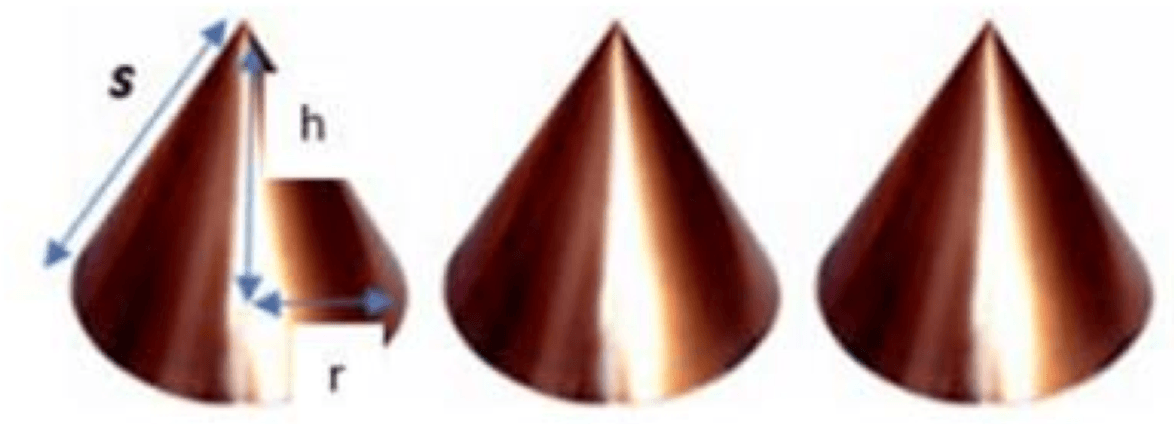
  11. You are a manufacturer of metal cones. In order to minimize the material used in the manufacturing process, you need to fabricate the metal cones shown below. You are provided with 3 copper cones with total volume of 15m315 m^3. Each cone consists of the flat base surface and lateral surface. Determine the possible dimensions of the lateral surface for each cone to estimate the amount of copper material needed to construct each cone’s lateral surface. (Given the dimensions of cone are height of the cone, hh, the slant length, ss, and the radius of the base, rr ).

    Figure for Question 13
    Solution

    Volume of each cone =13πr2h=5,h=15πr2=\frac{1}{3} \pi r^{2} h=5, \quad h=\frac{15}{\pi r^{2}}

    Area, A(r)\mathrm{A}(r) in terms of rr by substituting hh.

    A(r)=πrs where s is the slant length, A(r)=πr(r2+h2)A(r)=πr(r2+(15πr2)2)\begin{aligned} \mathrm{A}(r)&=\pi r s \quad \text { where } s \text { is the slant length, } \\ \mathrm{A}(r)&=\pi r\left(\sqrt{r^{2}+h^{2}}\right) \\ \mathrm{A}(r)&=\pi r\left(\sqrt{r^{2}+\left(\frac{15}{\pi r^{2}}\right)^{2}}\right) \end{aligned}

    Since πrs=πrr2+225π2r4=π2r6+225r\pi r s=\pi r\sqrt{r^{2}+\dfrac{225}{\pi^{2}r^{4}}}=\dfrac{\sqrt{\pi^{2}r^{6}+225}}{r}, differentiate exactly:

    A′(r)=2π2r6−225r2π2r6+225.\begin{aligned} A'(r) &=\frac{2\pi^{2}r^{6}-225}{r^{2}\sqrt{\pi^{2}r^{6}+225}}. \end{aligned}

    Because r>0r>0 and the denominator is positive, A′(r)=0A'(r)=0 gives

    2π2r6=225,r=(2252π2)1/6≈1.5002 m.2\pi^{2}r^{6}=225, \qquad r=\left(\frac{225}{2\pi^{2}}\right)^{1/6}\approx1.5002\ \mathrm{m}.

    The area tends to infinity as r→0+r\to0^{+} or r→∞r\to\infty, so this critical point is the global minimum.

    Hence, dimension :

    • Radius, r≈1.5002 mr\approx1.5002\ \mathrm{m},
    • Height, h=15πr2≈2.1216 m\displaystyle h=\frac{15}{\pi r^{2}}\approx2.1216\ \mathrm{m}
    • Slant length, s=r2+h2≈2.5984 ms=\sqrt{r^{2}+h^{2}}\approx2.5984\ \mathrm{m}
    note

    The calculation above minimises only the lateral surface, because that is the quantity requested in the final sentence of the question. If the flat base is also part of the material cost, use A=πr2+πrsA=\pi r^{2}+\pi r s; that interpretation gives approximately r=1.1907 mr=1.1907\ \mathrm{m}, h=3.3678 mh=3.3678\ \mathrm{m}, and s=3.5721 ms=3.5721\ \mathrm{m}.